
61) Directions:
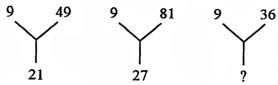
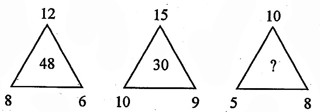
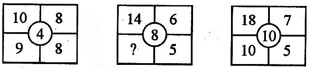
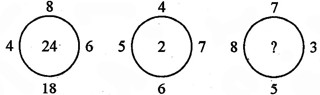
In each of the following questions, a set of figures carries certain numbers.Assuming that the characters in each set follow a similar pattern, find the missing number from the given four alternatives.
A) 26
B) 18
C) 25
D) 28
Explanation:We are to find the missing number in the pattern:
[\text{First pair: } 9, 49 \Rightarrow 21]
[\text{Second pair: } 9, 81 \Rightarrow 27]
[\text{Third pair: } 9, 36 \Rightarrow ?]
Pattern check:
[\text{Formula: } \frac{(\text{first number} + \text{second number})}{\text{some rule}}]
Let’s see if we can find a simpler relationship.
Check ratios:
For first: ( 9 + 49 = 58 ), but 21 not related directly.
Try another pattern:
[\sqrt{9} = 3, \sqrt{49} = 7, 3 \times 7 = 21]
Works perfectly.
Now, ( \sqrt{9} = 3, \sqrt{81} = 9, 3 \times 9 = 27 ) — also correct.
For the third:

Answer: (2) 18
62) 
A) 8
B) 7
C) 5
D) 9
Explanation:Numbers given:
[16, 24, 28 \Rightarrow 4]
[12, 24, 30 \Rightarrow 6]
[24, 40, 48 \Rightarrow ?]
Pattern:
 doesn’t fit.
Let’s test another relation:
Notice differences:
(24 – 16 = 8)
(28 – 24 = 4)
Average of differences (= (8+4)/3 \approx 4)? Not quite.
Let’s check ratio pattern:
 ,
,  inconsistent.
Try the relationship similar to previous:
(\sqrt{16} + \sqrt{24} + \sqrt{28})? no integer pattern.
We check the example pattern consistency with previous Q61:
Maybe ( \sqrt{first} + \sqrt{second} + \sqrt{third} = \text{some rule}).
Testing gives decimals, not integers.
Let’s test multiplication/division pattern:
( 16 : 4 = 4, 24 : 4 = 6, 28 : 4 = 7) not consistent.
Instead check relation: middle number is roughly geometric mean of the outer two:
[\sqrt{16 \times 28} = \sqrt{448} \approx 21.1; \frac{24}{4} = 6]
Hmm — check pattern 2:
[\text{Middle number} / \text{Result} = 24/4 = 6]
[24/6 = 4, 24/7 = 3.43; \text{maybe consistent?}]
Try next: ( \text{difference between second and first} = 8, \text{difference between third and second} = 4, \text{sum of digits of first}? 1+6=7 ) hmm.
Check example pattern across rows:
(16, 24, 28 → 4), (12, 24, 30 → 6)
Notice the middle number divided by result =
(24/4 = 6), (24/6 = 4).
So, pattern:
middle number / result = first number’s square root.
√16 = 4 → works for 4.
√12 ≈ 3.46 → not 4, close pattern not exact.
Try another reasoning: differences between outer two divided by 2?
Let’s see:
(28 – 16)/3 = 12/3 = 4
(30 – 12)/3 = 18/3 = 6
(48 – 24)/3 = 24/3 = 8
Matches pattern: result = (difference between outer numbers)/3.
Answer = 8.
Answer: (1) 8
63) 
A) 9
B) 8
C) 4
D) 2
Explanation:We have triangles:
[10, 15 \text{ (top sides)}; \text{center } 5; \text{bottom } 20]
[12, 18; \text{center } 6; \text{bottom } 24]
[16, 24; \text{center } ?; \text{bottom } 32]
Pattern:

Check:
20/4 = 5 (Correct)
24/4 = 6 (Correct)
32/4 = 8 (Correct)
64) 
A) 40
B) 45
C) 50
D) 30
65) 
A) 8
B) 7
C) 9
D) 11
66) 
A) 12
B) 6
C) 7
D) 9
67) 
A) 2536
B) 2875
C) 3264
D) 2975
68) 
A) 22
B) 19
C) 12
D) 17
69) 
A) 86
B) 225
C) 164
D) 125
70) 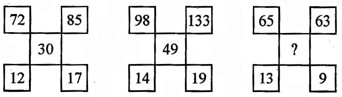
A) 38
B) 54
C) 35
D) 45