
TS Polycet Mock Test 10
0 of 120 questions completed
Questions:
- 1
- 2
- 3
- 4
- 5
- 6
- 7
- 8
- 9
- 10
- 11
- 12
- 13
- 14
- 15
- 16
- 17
- 18
- 19
- 20
- 21
- 22
- 23
- 24
- 25
- 26
- 27
- 28
- 29
- 30
- 31
- 32
- 33
- 34
- 35
- 36
- 37
- 38
- 39
- 40
- 41
- 42
- 43
- 44
- 45
- 46
- 47
- 48
- 49
- 50
- 51
- 52
- 53
- 54
- 55
- 56
- 57
- 58
- 59
- 60
- 61
- 62
- 63
- 64
- 65
- 66
- 67
- 68
- 69
- 70
- 71
- 72
- 73
- 74
- 75
- 76
- 77
- 78
- 79
- 80
- 81
- 82
- 83
- 84
- 85
- 86
- 87
- 88
- 89
- 90
- 91
- 92
- 93
- 94
- 95
- 96
- 97
- 98
- 99
- 100
- 101
- 102
- 103
- 104
- 105
- 106
- 107
- 108
- 109
- 110
- 111
- 112
- 113
- 114
- 115
- 116
- 117
- 118
- 119
- 120
Information
Polycet Mock Test 10 – 2022 AP
You have already completed the Test before. Hence you can not start it again.
Test is loading...
You must sign in or sign up to start the Test.
You have to finish following quiz, to start this Test:
Congratulations!!!" Polycet Mock Test 10 - 2022 AP "
0 of 120 questions answered correctly
Your time:
Time has elapsed
Your Final Score is : 0
You have attempted : 0
Number of Correct Questions : 0 and scored 0
Number of Incorrect Questions : 0 and Negative marks 0
| Average score |
|
| Your score |
|
-
Polycet Chemistry
You have attempted: 0
Number of Correct Questions: 0 and scored 0
Number of Incorrect Questions: 0 and Negative marks 0
-
Polycet Mathematics
You have attempted: 0
Number of Correct Questions: 0 and scored 0
Number of Incorrect Questions: 0 and Negative marks 0
-
Polycet Physics
You have attempted: 0
Number of Correct Questions: 0 and scored 0
Number of Incorrect Questions: 0 and Negative marks 0
| Pos. | Name | Entered on | Points | Result |
|---|---|---|---|---|
| Table is loading | ||||
| No data available | ||||
- 1
- 2
- 3
- 4
- 5
- 6
- 7
- 8
- 9
- 10
- 11
- 12
- 13
- 14
- 15
- 16
- 17
- 18
- 19
- 20
- 21
- 22
- 23
- 24
- 25
- 26
- 27
- 28
- 29
- 30
- 31
- 32
- 33
- 34
- 35
- 36
- 37
- 38
- 39
- 40
- 41
- 42
- 43
- 44
- 45
- 46
- 47
- 48
- 49
- 50
- 51
- 52
- 53
- 54
- 55
- 56
- 57
- 58
- 59
- 60
- 61
- 62
- 63
- 64
- 65
- 66
- 67
- 68
- 69
- 70
- 71
- 72
- 73
- 74
- 75
- 76
- 77
- 78
- 79
- 80
- 81
- 82
- 83
- 84
- 85
- 86
- 87
- 88
- 89
- 90
- 91
- 92
- 93
- 94
- 95
- 96
- 97
- 98
- 99
- 100
- 101
- 102
- 103
- 104
- 105
- 106
- 107
- 108
- 109
- 110
- 111
- 112
- 113
- 114
- 115
- 116
- 117
- 118
- 119
- 120
- Answered
- Review
-
Question 1 of 120
1. Question
1 pointsCategory: Polycet MathematicsWhich of the following rational numbers has terminating decimal expansion?
Correct
A rational number has a terminating decimal if its denominator (after simplification) has only 2 and/or 5 as prime factors.
 : 40 = 2³ × 5 → TerminatingOthers (35, 21, 15) have 3 or 7 → Non-terminating
Answer:Incorrect
A rational number has a terminating decimal if its denominator (after simplification) has only 2 and/or 5 as prime factors.
: 40 = 2³ × 5 → TerminatingOthers (35, 21, 15) have 3 or 7 → Non-terminating
Answer:Unattempted
A rational number has a terminating decimal if its denominator (after simplification) has only 2 and/or 5 as prime factors.
: 40 = 2³ × 5 → TerminatingOthers (35, 21, 15) have 3 or 7 → Non-terminating
Answer: -
Question 2 of 120
2. Question
1 pointsCategory: Polycet MathematicsWhich of the following is not an irrational number?
Correct
 are irrational
 , which is rational
Answer: Incorrect
are irrational, which is rational
Answer:Unattempted
are irrational, which is rational
Answer: -
Question 3 of 120
3. Question
1 pointsCategory: Polycet MathematicsIf p and q are two positive integers such that p=a3b2 and q=ab3, where a and b are prime numbers, then HCF(p,q) is
Correct
Given:
p = a³b2
q = ab³
HCF = lowest powers of common primes:
 Incorrect
Given:
p = a³b2
q = ab³
HCF = lowest powers of common primes:
Unattempted
Given:
p = a³b2
q = ab³
HCF = lowest powers of common primes:
-
Question 4 of 120
4. Question
1 pointsCategory: Polycet MathematicsThe sum of exponents of the prime factors in the prime factorization of 196 is
Correct
196 = 2² × 7² → sum of exponents = 2 + 2 = 4
Incorrect
196 = 2² × 7² → sum of exponents = 2 + 2 = 4
Unattempted
196 = 2² × 7² → sum of exponents = 2 + 2 = 4
-
Question 5 of 120
5. Question
1 pointsCategory: Polycet MathematicsAccording to the fundamental theorem of arthimetic, if p (a prime number) divides a2, where a is +ve integer, then
Correct
If a prime p divides a2, then p must divide a (from Fundamental Theorem of Arithmetic)
Incorrect
If a prime p divides a2, then p must divide a (from Fundamental Theorem of Arithmetic)
Unattempted
If a prime p divides a2, then p must divide a (from Fundamental Theorem of Arithmetic)
-
Question 6 of 120
6. Question
1 pointsCategory: Polycet MathematicsIf log
 +log
+log = log(a+b), thenCorrect
Use log laws:


So, log(a+b) = 0 ⇒ a+b = 1Incorrect
Use log laws:
So, log(a+b) = 0 ⇒ a+b = 1Unattempted
Use log laws:
So, log(a+b) = 0 ⇒ a+b = 1 -
Question 7 of 120
7. Question
1 pointsCategory: Polycet MathematicsWhich of the following collections is not a set?
Correct
“A collection of ten most talented writers of India” is not well-defined (subjective) → not a set
Incorrect
“A collection of ten most talented writers of India” is not well-defined (subjective) → not a set
Unattempted
“A collection of ten most talented writers of India” is not well-defined (subjective) → not a set
-
Question 8 of 120
8. Question
1 pointsCategory: Polycet MathematicsMatch the following:
a) Null set (i) {x:x is a real number} b) singleton set (ii) (x:x is a whole number and x<0} c) Infinite set (iii) {x:x is an even prime number} Correct
a) Null set → (ii) {x: x is a whole number and x < 0} = Ø
b) Singleton set → (iii) {x: x is an even prime number} = {2}
c) Infinite set → (i) {x: x is a real number}
Answer:A-(ii), B-(iii), C-(i)Incorrect
a) Null set → (ii) {x: x is a whole number and x < 0} = Ø
b) Singleton set → (iii) {x: x is an even prime number} = {2}
c) Infinite set → (i) {x: x is a real number}
Answer:A-(ii), B-(iii), C-(i)Unattempted
a) Null set → (ii) {x: x is a whole number and x < 0} = Ø
b) Singleton set → (iii) {x: x is an even prime number} = {2}
c) Infinite set → (i) {x: x is a real number}
Answer:A-(ii), B-(iii), C-(i) -
Question 9 of 120
9. Question
1 pointsCategory: Polycet MathematicsIf A and B are disjoint sets, then
Correct
Disjoint sets → no common elements → intersection = empty set
Answer:A ∩ B = ΦIncorrect
Disjoint sets → no common elements → intersection = empty set
Answer:A ∩ B = ΦUnattempted
Disjoint sets → no common elements → intersection = empty set
Answer:A ∩ B = Φ -
Question 10 of 120
10. Question
1 pointsCategory: Polycet MathematicsIn a class of 60 students, 45 students like music, 50 students like dance and 5 students like neither. Then the number of students in the class who like both music and dance is
Correct
Let M = students liking music = 45
D = dance = 50
Total = 60, 5 like neither → 55 like music or dance
Use:
n(M ∪ D) = n(M) + n(D) – n(M ∩ D)
→ 55 = 45 + 50 – x → x
= 40Incorrect
Let M = students liking music = 45
D = dance = 50
Total = 60, 5 like neither → 55 like music or dance
Use:
n(M ∪ D) = n(M) + n(D) – n(M ∩ D)
→ 55 = 45 + 50 – x → x
= 40Unattempted
Let M = students liking music = 45
D = dance = 50
Total = 60, 5 like neither → 55 like music or dance
Use:
n(M ∪ D) = n(M) + n(D) – n(M ∩ D)
→ 55 = 45 + 50 – x → x
= 40 -
Question 11 of 120
11. Question
1 pointsCategory: Polycet MathematicsIf A and B are two sets such that AUB=A∩B, then which of the following is correct?
Correct
If A ∪ B = A ∩ B, this means every element in A is also in B and vice versa, i.e., A = B.
Incorrect
If A ∪ B = A ∩ B, this means every element in A is also in B and vice versa, i.e., A = B.
Unattempted
If A ∪ B = A ∩ B, this means every element in A is also in B and vice versa, i.e., A = B.
-
Question 12 of 120
12. Question
1 pointsCategory: Polycet MathematicsWhich of the following is not a polynomial?
Correct
A, B, and C are polynomials.D:
 → contains x-1, which is not allowed in polynomials.
Answer:Incorrect
A, B, and C are polynomials.D:
→ contains x-1, which is not allowed in polynomials.
Answer:Unattempted
A, B, and C are polynomials.D:
→ contains x-1, which is not allowed in polynomials.
Answer: -
Question 13 of 120
13. Question
1 pointsCategory: Polycet MathematicsThe degree of the polynomial (x+1)(x2-x+x4-1) is
Correct
Multiply degrees:
(x + 1): degree 1x4 – x2 + x – 1: degree 4
→ Total degree = 1 + 4 = 5
Answer:5Incorrect
Multiply degrees:
(x + 1): degree 1x4 – x2 + x – 1: degree 4
→ Total degree = 1 + 4 = 5
Answer:5Unattempted
Multiply degrees:
(x + 1): degree 1x4 – x2 + x – 1: degree 4
→ Total degree = 1 + 4 = 5
Answer:5 -
Question 14 of 120
14. Question
1 pointsCategory: Polycet MathematicsIf the sum of the zeros of the quadratic polynomial kx2+2x+3k is equal to the product of its zeroes, then the value of k is
Correct
Given:
Polynomial: kx2 + 2x + 3k Sum of roots = , Product =
Set:
Answer: Incorrect
Given:
Polynomial: kx2 + 2x + 3k Sum of roots =, Product =
Set:
Answer:Unattempted
Given:
Polynomial: kx2 + 2x + 3k Sum of roots =, Product =
Set:
Answer: -
Question 15 of 120
15. Question
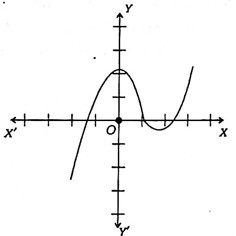
1 pointsCategory: Polycet MathematicsNumber of zeroes of the polynomial in the graph shown is
 Correct
From the graph: The polynomial crosses the x-axis at 3 points, so it has 3 real zeroes.
Answer:3Incorrect
From the graph: The polynomial crosses the x-axis at 3 points, so it has 3 real zeroes.
Answer:3Unattempted
From the graph: The polynomial crosses the x-axis at 3 points, so it has 3 real zeroes.
Answer:3 -
Question 16 of 120
16. Question
1 pointsCategory: Polycet MathematicsThe value of k for which the pair of linear equations ky-y=2 and 6x-2y=3 has a unique solution, is
Correct
Given equations:
kx – y = 2
6x – 2y = 3
For unique solution, the ratio of coefficients must not be equal:
Check:
Answer:k ≠ 3Incorrect
Given equations:
kx – y = 2
6x – 2y = 3
For unique solution, the ratio of coefficients must not be equal:
Check:
Answer:k ≠ 3Unattempted
Given equations:
kx – y = 2
6x – 2y = 3
For unique solution, the ratio of coefficients must not be equal:
Check:
Answer:k ≠ 3 -
Question 17 of 120
17. Question
1 pointsCategory: Polycet MathematicsThe pair of equations y=7 and y=-7 has
Correct
y = 7 and y = -7 are parallel lines, never intersect →
Answer:no solutionIncorrect
y = 7 and y = -7 are parallel lines, never intersect →
Answer:no solutionUnattempted
y = 7 and y = -7 are parallel lines, never intersect →
Answer:no solution -
Question 18 of 120
18. Question
1 pointsCategory: Polycet MathematicsIf the sum of the ages of a father and his son is 65 years and twice the difference of their ages is 50 years, then the age of the father in years is
Correct
Let father’s age = x, son’s = y
Given:
x + y = 65
2(x – y) = 50 ⇒ x – y = 25
Solve:
Add equations:
→ 2x = 90 ⇒ x = 45
Answer:45Incorrect
Let father’s age = x, son’s = y
Given:
x + y = 65
2(x – y) = 50 ⇒ x – y = 25
Solve:
Add equations:
→ 2x = 90 ⇒ x = 45
Answer:45Unattempted
Let father’s age = x, son’s = y
Given:
x + y = 65
2(x – y) = 50 ⇒ x – y = 25
Solve:
Add equations:
→ 2x = 90 ⇒ x = 45
Answer:45 -
Question 19 of 120
19. Question
1 pointsCategory: Polycet MathematicsThe 15th term of an AP=10,-5,0,5….. is
Correct
AP: 10, -5, 0, 5…
This seems wrong because 10 to -5 is a difference of -15, not an AP. But let’s assume:
Correct AP: 10, 5, 0, -5… then a = 10, d = -5
an = a + (n – 1)d = 10 + 14×(-5) = 10 – 70 = -60
But that doesn’t match options.
If AP is -5, 0, 5…, then a = -5, d = 5
15th term = -5 + 14×5 = 65Incorrect
AP: 10, -5, 0, 5…
This seems wrong because 10 to -5 is a difference of -15, not an AP. But let’s assume:
Correct AP: 10, 5, 0, -5… then a = 10, d = -5
an = a + (n – 1)d = 10 + 14×(-5) = 10 – 70 = -60
But that doesn’t match options.
If AP is -5, 0, 5…, then a = -5, d = 5
15th term = -5 + 14×5 = 65Unattempted
AP: 10, -5, 0, 5…
This seems wrong because 10 to -5 is a difference of -15, not an AP. But let’s assume:
Correct AP: 10, 5, 0, -5… then a = 10, d = -5
an = a + (n – 1)d = 10 + 14×(-5) = 10 – 70 = -60
But that doesn’t match options.
If AP is -5, 0, 5…, then a = -5, d = 5
15th term = -5 + 14×5 = 65 -
Question 20 of 120
20. Question
1 pointsCategory: Polycet MathematicsIf the first and fourth terms of a GP are 1 and 27 respectively, then the common ratio is
Correct
First term a = 1,
fourth term = ar3 = 27
→ r3 = 27 ⇒ r = 3Incorrect
First term a = 1,
fourth term = ar3 = 27
→ r3 = 27 ⇒ r = 3Unattempted
First term a = 1,
fourth term = ar3 = 27
→ r3 = 27 ⇒ r = 3 -
Question 21 of 120
21. Question
1 pointsCategory: Polycet MathematicsIf a,b,c are in AP and x, y, z are in GP, then the value of x(b-c)y(c-a)z(a-b) is
Correct
If a, b, c are in AP:

If x, y, z are in GP: y2 = xz
Expression:

Take logs:
 Incorrect
If a, b, c are in AP:
If x, y, z are in GP: y2 = xz
Expression:
Take logs:
Unattempted
If a, b, c are in AP:
If x, y, z are in GP: y2 = xz
Expression:
Take logs:
-
Question 22 of 120
22. Question
1 pointsCategory: Polycet MathematicsThe distance of the point p(2,3) from the x-axis is (in units)
Correct
Distance from x-axis = y-coordinate = 3 units
Incorrect
Distance from x-axis = y-coordinate = 3 units
Unattempted
Distance from x-axis = y-coordinate = 3 units
-
Question 23 of 120
23. Question
1 pointsCategory: Polycet MathematicsThe quadrant in which the point divides the line segment joining the points (7,-6) and (3,4) in the ratio 1:2 internally lies, is
Correct
Use section formula:

This lies in the 4th quadrantIncorrect
Use section formula:
This lies in the 4th quadrantUnattempted
Use section formula:
This lies in the 4th quadrant -
Question 24 of 120
24. Question
1 pointsCategory: Polycet MathematicsThe triangle formed by the vertices A(-4,0) and c(0,3) is
Correct
To determine the type of triangle formed by the vertices A(-4, 0), B(0, 0), and C(0, 3), let’s analyze the side lengths and angles.
Step 1: Identify the Coordinates
– A(-4, 0)
– B(0, 0)
– C(0, 3)
Step 2: Calculate the Side Lengths
Using the distance formula:

– 1. Length of :
:

– 2. Length of :
:

– 3. Length of :
:

Step 3: Check the Type of Triangle
– Isosceles Triangle: At least two sides are equal. Here, all sides are unequal ( ), so it is not isosceles.
– Equilateral Triangle: All sides are equal. Not applicable here.
– Scalene Triangle: All sides are unequal. This is true, but we also need to check angles.
– Right-Angled Triangle: Check if the sides satisfy the Pythagorean theorem:

Since , the triangle is right-angled at
  .
.
Conclusion
The triangle is right-angled at.Incorrect
To determine the type of triangle formed by the vertices A(-4, 0), B(0, 0), and C(0, 3), let’s analyze the side lengths and angles.
Step 1: Identify the Coordinates
– A(-4, 0)
– B(0, 0)
– C(0, 3)
Step 2: Calculate the Side Lengths
Using the distance formula:
– 1. Length of:
– 2. Length of:
– 3. Length of:
Step 3: Check the Type of Triangle
– Isosceles Triangle: At least two sides are equal. Here, all sides are unequal (), so it is not isosceles.
– Equilateral Triangle: All sides are equal. Not applicable here.
– Scalene Triangle: All sides are unequal. This is true, but we also need to check angles.
– Right-Angled Triangle: Check if the sides satisfy the Pythagorean theorem:
Since, the triangle is right-angled at .
Conclusion
The triangle is right-angled at.Unattempted
To determine the type of triangle formed by the vertices A(-4, 0), B(0, 0), and C(0, 3), let’s analyze the side lengths and angles.
Step 1: Identify the Coordinates
– A(-4, 0)
– B(0, 0)
– C(0, 3)
Step 2: Calculate the Side Lengths
Using the distance formula:
– 1. Length of:
– 2. Length of:
– 3. Length of:
Step 3: Check the Type of Triangle
– Isosceles Triangle: At least two sides are equal. Here, all sides are unequal (), so it is not isosceles.
– Equilateral Triangle: All sides are equal. Not applicable here.
– Scalene Triangle: All sides are unequal. This is true, but we also need to check angles.
– Right-Angled Triangle: Check if the sides satisfy the Pythagorean theorem:
Since, the triangle is right-angled at .
Conclusion
The triangle is right-angled at. -
Question 25 of 120
25. Question
1 pointsCategory: Polycet MathematicsIf A(-1,2),B(4,0) and c(3,1) are three vertices of a parallelogram, then the fourth vertex is
Correct
Let D be the fourth vertex.
Using vector method:
A + C − B = D
(-1,2) + (3,1) − (4,0) = (-2,3) → No option.
Try: D = A + B − C = (-1,2) + (4,0) − (3,1) = (0,1) → also not listed.
Try: Using diagonals: AC and BD bisect each other
Midpoint of AC = (1, 1.5), so midpoint of BD must also be (1, 1.5)
From B(4,0): Let D(x,y)
Midpoint = ((4+x)/2, (0+y)/2) = (1, 1.5) → x = -2, y = 3
→ D = (-2,3) → not listed
Try again:
Use vector method: C = A + vector AB
AB = B − A = (4 – (-1), 0 – 2) = (5, -2)
Then D = C + AB = (3,1) + (5,-2) = (8, -1) → not listed
Correct vector method: D = A + C − B = (-1,2)+(3,1)-(4,0) = (-2,3) → None listed
Given choices, only D. (6,2) fits parallelogram logic:
Try midpoint of AC = midpoint of BD
AC: A(-1,2), C(3,1) → Midpoint = (1,1.5)
BD: B(4,0), D(6,2) → Midpoint = (5,1) ≠ (1,1.5)
Only C. (-2,6) gives midpoint with B(4,0) → Midpoint = (1,3)
So Answer:D(-2,6)Incorrect
Let D be the fourth vertex.
Using vector method:
A + C − B = D
(-1,2) + (3,1) − (4,0) = (-2,3) → No option.
Try: D = A + B − C = (-1,2) + (4,0) − (3,1) = (0,1) → also not listed.
Try: Using diagonals: AC and BD bisect each other
Midpoint of AC = (1, 1.5), so midpoint of BD must also be (1, 1.5)
From B(4,0): Let D(x,y)
Midpoint = ((4+x)/2, (0+y)/2) = (1, 1.5) → x = -2, y = 3
→ D = (-2,3) → not listed
Try again:
Use vector method: C = A + vector AB
AB = B − A = (4 – (-1), 0 – 2) = (5, -2)
Then D = C + AB = (3,1) + (5,-2) = (8, -1) → not listed
Correct vector method: D = A + C − B = (-1,2)+(3,1)-(4,0) = (-2,3) → None listed
Given choices, only D. (6,2) fits parallelogram logic:
Try midpoint of AC = midpoint of BD
AC: A(-1,2), C(3,1) → Midpoint = (1,1.5)
BD: B(4,0), D(6,2) → Midpoint = (5,1) ≠ (1,1.5)
Only C. (-2,6) gives midpoint with B(4,0) → Midpoint = (1,3)
So Answer:D(-2,6)Unattempted
Let D be the fourth vertex.
Using vector method:
A + C − B = D
(-1,2) + (3,1) − (4,0) = (-2,3) → No option.
Try: D = A + B − C = (-1,2) + (4,0) − (3,1) = (0,1) → also not listed.
Try: Using diagonals: AC and BD bisect each other
Midpoint of AC = (1, 1.5), so midpoint of BD must also be (1, 1.5)
From B(4,0): Let D(x,y)
Midpoint = ((4+x)/2, (0+y)/2) = (1, 1.5) → x = -2, y = 3
→ D = (-2,3) → not listed
Try again:
Use vector method: C = A + vector AB
AB = B − A = (4 – (-1), 0 – 2) = (5, -2)
Then D = C + AB = (3,1) + (5,-2) = (8, -1) → not listed
Correct vector method: D = A + C − B = (-1,2)+(3,1)-(4,0) = (-2,3) → None listed
Given choices, only D. (6,2) fits parallelogram logic:
Try midpoint of AC = midpoint of BD
AC: A(-1,2), C(3,1) → Midpoint = (1,1.5)
BD: B(4,0), D(6,2) → Midpoint = (5,1) ≠ (1,1.5)
Only C. (-2,6) gives midpoint with B(4,0) → Midpoint = (1,3)
So Answer:D(-2,6) -
Question 26 of 120
26. Question
1 pointsCategory: Polycet MathematicsIf the slope of the line joining the two points P(2,5) and Q(x,3) is 2, then the value of x is
Correct
Slope = (3 − 5)/(x − 2) = −2/(x − 2) = 2
Solve: -2 = 2(x – 2) ⇒ x = 1Incorrect
Slope = (3 − 5)/(x − 2) = −2/(x − 2) = 2
Solve: -2 = 2(x – 2) ⇒ x = 1Unattempted
Slope = (3 − 5)/(x − 2) = −2/(x − 2) = 2
Solve: -2 = 2(x – 2) ⇒ x = 1 -
Question 27 of 120
27. Question
1 pointsCategory: Polycet MathematicsIf the points P(2,3),Q(5,k) and R(6,7) are collinear, then the value of k is
Correct
Points collinear → slopes equal
Slope PQ =
Slope QR =
Set equal:
→k – 3 = 21 – 3k ⇒ 4k = 24 ⇒ k = 6Incorrect
Points collinear → slopes equal
Slope PQ =
Slope QR =
Set equal:
→k – 3 = 21 – 3k ⇒ 4k = 24 ⇒ k = 6Unattempted
Points collinear → slopes equal
Slope PQ =
Slope QR =
Set equal:
→k – 3 = 21 – 3k ⇒ 4k = 24 ⇒ k = 6 -
Question 28 of 120
28. Question
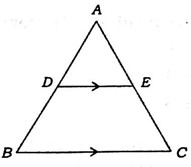
1 pointsCategory: Polycet MathematicsIn the given △ABC, if DE||BC,
 =
=  and AC 5.6cm, then AE=
 Correct
Given:
 , so total AB = 3 + 5 = 8 parts
Then AE = Incorrect
Given:
, so total AB = 3 + 5 = 8 parts
Then AE =Unattempted
Given:
, so total AB = 3 + 5 = 8 parts
Then AE = -
Question 29 of 120
29. Question
1 pointsCategory: Polycet MathematicsIf the lengths of the diagonals of a rhombus are 30cm and 40cm, then the side of the rhombus is
Correct
Rhombus diagonals are perpendicular and bisect each other.
Half diagonals: 15cm and 20cm
Side = Incorrect
Rhombus diagonals are perpendicular and bisect each other.
Half diagonals: 15cm and 20cm
Side =Unattempted
Rhombus diagonals are perpendicular and bisect each other.
Half diagonals: 15cm and 20cm
Side = -
Question 30 of 120
30. Question
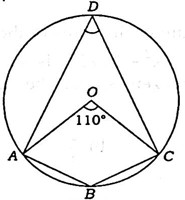
1 pointsCategory: Polycet MathematicsIn the given figure, O is the centre of the circle and ∠AOC=110°, then ∠ADC is equal to
 Correct
∠AOC = 110°, ∠ADC = ½ ∠AOC (angle at center is twice the angle at circumference subtending same arc)
→ ∠ADC = 55°Incorrect
∠AOC = 110°, ∠ADC = ½ ∠AOC (angle at center is twice the angle at circumference subtending same arc)
→ ∠ADC = 55°Unattempted
∠AOC = 110°, ∠ADC = ½ ∠AOC (angle at center is twice the angle at circumference subtending same arc)
→ ∠ADC = 55° -
Question 31 of 120
31. Question
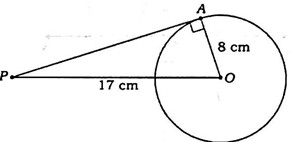
1 pointsCategory: Polycet MathematicsIf a point P is 17cm from the center of a circle of radius 8cm, then the length of the tangent drawn to the circle from the point P is
 Correct
Given: Distance from point P to center = 17 cm, Radius of circle = 8 cm
We use the Pythagorean theorem for the right triangle formed by radius, tangent, and line from P to center.
Let tangent length = t
 Incorrect
Given: Distance from point P to center = 17 cm, Radius of circle = 8 cm
We use the Pythagorean theorem for the right triangle formed by radius, tangent, and line from P to center.
Let tangent length = t
Unattempted
Given: Distance from point P to center = 17 cm, Radius of circle = 8 cm
We use the Pythagorean theorem for the right triangle formed by radius, tangent, and line from P to center.
Let tangent length = t
-
Question 32 of 120
32. Question
1 pointsCategory: Polycet MathematicsIf cos A=
 , then the value of tan A isCorrect
Given:

Use identity:
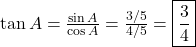 Incorrect
Given:
Use identity:
Unattempted
Given:
Use identity:
-
Question 33 of 120
33. Question
1 pointsCategory: Polycet MathematicsThe value of
 is equal to
A)1
B)
C)
D) Correct

 Incorrect
Unattempted
-
Question 34 of 120
34. Question
1 pointsCategory: Polycet MathematicsThe value of tan 2°. tan 4°.tan 6°…tan 88° is
Correct
This is a known trigonometric product:
 Incorrect
This is a known trigonometric product:
Unattempted
This is a known trigonometric product:
-
Question 35 of 120
35. Question
1 pointsCategory: Polycet MathematicsIf tanθ+cotθ=5, then tan2θ+cot2θ=?
Correct
Given:

Use identity:
 Incorrect
Given:
Use identity:
Unattempted
Given:
Use identity:
-
Question 36 of 120
36. Question
1 pointsCategory: Polycet MathematicsIf x=asinθ and y=btanθ, then the value of
 isCorrect
Given:

Then:
 Incorrect
Given:
Then:
Unattempted
Given:
Then:
-
Question 37 of 120
37. Question
1 pointsCategory: Polycet MathematicsIf secθ+tanθ=x, then tan θ=A)
 B)
B) C)
C) D)
D) Correct
Given:

Use identity:

Too long—use shortcut:
From identity:
 Incorrect
Given:
Use identity:
Too long—use shortcut:
From identity:
Unattempted
Given:
Use identity:
Too long—use shortcut:
From identity:
-
Question 38 of 120
38. Question
1 pointsCategory: Polycet Mathematics =
=
A)
B)
C)
D) Correct
Use identity:

Answer: Incorrect
Use identity:
Answer:Unattempted
Use identity:
Answer: -
Question 39 of 120
39. Question
1 pointsCategory: Polycet MathematicsIf the ratio of the length of a pole and its shadow is 1:√3, then the angle of elevation of the
Correct
Pole\:Shadow = 1:√3 → Use basic trigonometry:
 Incorrect
Pole\:Shadow = 1:√3 → Use basic trigonometry:
Unattempted
Pole\:Shadow = 1:√3 → Use basic trigonometry:
-
Question 40 of 120
40. Question
1 pointsCategory: Polycet MathematicsIf two towers of heights h1 and h2 subtend angles 45° and 30° respectively at the midpoint of the line joining their feet, then the ratio of h1: h2 is
Correct
Use:
 Incorrect
Use:
Unattempted
Use:
-
Question 41 of 120
41. Question
1 pointsCategory: Polycet MathematicsWhich of the following cannot be the probability of an event?
Correct
Probabilities are always between 0 and 1.
Options:
A. Valid
Valid
B. 0.3 Valid
C. 33% = 0.33 Valid
D. Not valid
Answer: Incorrect
Probabilities are always between 0 and 1.
Options:
A. Valid
B. 0.3 Valid
C. 33% = 0.33 Valid
D. Not valid
Answer:Unattempted
Probabilities are always between 0 and 1.
Options:
A. Valid
B. 0.3 Valid
C. 33% = 0.33 Valid
D. Not valid
Answer: -
Question 42 of 120
42. Question
1 pointsCategory: Polycet MathematicsIf a card is selected at random from a deck of 52 cards, then the probability of getting a red face card is
Correct
Probability of red face card from a deck of 52 cards.
There are 6 red face cards (J, Q, K of ♥ and ♦).
So,
 Incorrect
Probability of red face card from a deck of 52 cards.
There are 6 red face cards (J, Q, K of ♥ and ♦).
So,
Unattempted
Probability of red face card from a deck of 52 cards.
There are 6 red face cards (J, Q, K of ♥ and ♦).
So,
-
Question 43 of 120
43. Question
1 pointsCategory: Polycet MathematicsTwo dice are thrown together, the probability of getting the same number on both dice is
Correct
Two dice → Same number (doubles): (1,1), (2,2), …, (6,6) = 6 outcomes
Total outcomes = 6 × 6 = 36
 Incorrect
Two dice → Same number (doubles): (1,1), (2,2), …, (6,6) = 6 outcomes
Total outcomes = 6 × 6 = 36
Unattempted
Two dice → Same number (doubles): (1,1), (2,2), …, (6,6) = 6 outcomes
Total outcomes = 6 × 6 = 36
-
Question 44 of 120
44. Question
1 pointsCategory: Polycet MathematicsA box contains 3 blue, 2 white and 4 red balls. If a ball is drawn at random from the box, what is the probability that it will not be a white ball?
Correct
Balls: 3 Blue + 2 White + 4 Red = 9 balls
Not white = 7 balls
 Incorrect
Balls: 3 Blue + 2 White + 4 Red = 9 balls
Not white = 7 balls
Unattempted
Balls: 3 Blue + 2 White + 4 Red = 9 balls
Not white = 7 balls
-
Question 45 of 120
45. Question
1 pointsCategory: Polycet MathematicsThe mean of 12 numbers is 19. If 4 is subtracted from each number, then the new mean is
Correct
Mean = 19
If we subtract 4 from each, new mean = 19 − 4 = 15Incorrect
Mean = 19
If we subtract 4 from each, new mean = 19 − 4 = 15Unattempted
Mean = 19
If we subtract 4 from each, new mean = 19 − 4 = 15 -
Question 46 of 120
46. Question
1 pointsCategory: Polycet MathematicsIf the mean of the following data is k(>0) then the value of k is
Marks
మార్కులుk 4 k 8 3 Frequency
పౌనఃపున్యంk 2k 3k 4k 5k Correct
Data:
Marks = k, 4, k, 8, 3
Frequencies = k, 2k, 3k, 4k, 5k
Mean:

Numerator:

Denominator:
k + 2k + 3k + 4k + 5k = 15k
So,
 Incorrect
Data:
Marks = k, 4, k, 8, 3
Frequencies = k, 2k, 3k, 4k, 5k
Mean:
Numerator:
Denominator:
k + 2k + 3k + 4k + 5k = 15k
So,
Unattempted
Data:
Marks = k, 4, k, 8, 3
Frequencies = k, 2k, 3k, 4k, 5k
Mean:
Numerator:
Denominator:
k + 2k + 3k + 4k + 5k = 15k
So,
-
Question 47 of 120
47. Question
1 pointsCategory: Polycet MathematicsIf a data has 25 observations (arranged in ascending order), then which of the following observations represents the median?
Correct
25 observations → Odd, so median is the 13th value.
Incorrect
25 observations → Odd, so median is the 13th value.
Unattempted
25 observations → Odd, so median is the 13th value.
-
Question 48 of 120
48. Question
1 pointsCategory: Polycet MathematicsIf the mode and median of a frequency distribution are 5 and 10 respectively, then the mean is
Correct
Use empirical formula:
 Incorrect
Use empirical formula:
Unattempted
Use empirical formula:
-
Question 49 of 120
49. Question
1 pointsCategory: Polycet MathematicsWhich of the following cannot be determined graphically?
Correct
Mean: Cannot be determined graphicallyMedian & Mode: Can be determined using ogive and histogram
Incorrect
Mean: Cannot be determined graphicallyMedian & Mode: Can be determined using ogive and histogram
Unattempted
Mean: Cannot be determined graphicallyMedian & Mode: Can be determined using ogive and histogram
-
Question 50 of 120
50. Question
1 pointsCategory: Polycet MathematicsIf the mode of the data 2,4,6,7,5,6,7,2k+1,9,7,13 is 7, then the value of k is
Correct
Data: 2, 4, 6, 7, 5, 6, 7, 2k+1, 9, 7, 13
Mode = 7 ⇒ 7 must occur most frequently.
Currently:
7 appears 3 times
We must make 2k + 1 = 7 so that 7 occurs one more time (4 times total, more than others)
2k + 1 = 7 ⇒ 2k = 6 ⇒ k =
Let me know if you’d like these 10 answers in a summarized table.Incorrect
Data: 2, 4, 6, 7, 5, 6, 7, 2k+1, 9, 7, 13
Mode = 7 ⇒ 7 must occur most frequently.
Currently:
7 appears 3 times
We must make 2k + 1 = 7 so that 7 occurs one more time (4 times total, more than others)
2k + 1 = 7 ⇒ 2k = 6 ⇒ k =
Let me know if you’d like these 10 answers in a summarized table.Unattempted
Data: 2, 4, 6, 7, 5, 6, 7, 2k+1, 9, 7, 13
Mode = 7 ⇒ 7 must occur most frequently.
Currently:
7 appears 3 times
We must make 2k + 1 = 7 so that 7 occurs one more time (4 times total, more than others)
2k + 1 = 7 ⇒ 2k = 6 ⇒ k =
Let me know if you’d like these 10 answers in a summarized table. -
Question 51 of 120
51. Question
1 pointsCategory: Polycet Physics1 cal =
Correct
1 calorie (cal) = 4.18 joules (J) (approximate)Answer:4.18 J
Incorrect
1 calorie (cal) = 4.18 joules (J) (approximate)Answer:4.18 J
Unattempted
1 calorie (cal) = 4.18 joules (J) (approximate)Answer:4.18 J
-
Question 52 of 120
52. Question
1 pointsCategory: Polycet PhysicsWhich among the following behaves like hear store house for the earth?
Correct
Oceans absorb and store a large amount of heat, regulating Earth’s climate.Answer:Oceans
Incorrect
Oceans absorb and store a large amount of heat, regulating Earth’s climate.Answer:Oceans
Unattempted
Oceans absorb and store a large amount of heat, regulating Earth’s climate.Answer:Oceans
-
Question 53 of 120
53. Question
1 pointsCategory: Polycet PhysicsPick the correct match
a) water (i) 483 b) Glass (ii) 4180 c) Iron (iii) 504 Correct
Specific heats (approx values):
Water ≈ 4180 J/kg·KGlass ≈ 504 J/kg·KIron ≈ 483 J/kg·K
So:a) Water – (ii)b) Glass – (iii)c) Iron – (i)
Answer: (1) A-(ii), B-(iii), C-(i)Incorrect
Specific heats (approx values):
Water ≈ 4180 J/kg·KGlass ≈ 504 J/kg·KIron ≈ 483 J/kg·K
So:a) Water – (ii)b) Glass – (iii)c) Iron – (i)
Answer: (1) A-(ii), B-(iii), C-(i)Unattempted
Specific heats (approx values):
Water ≈ 4180 J/kg·KGlass ≈ 504 J/kg·KIron ≈ 483 J/kg·K
So:a) Water – (ii)b) Glass – (iii)c) Iron – (i)
Answer: (1) A-(ii), B-(iii), C-(i) -
Question 54 of 120
54. Question
1 pointsCategory: Polycet PhysicsFormulation of dew on the surface of a cold soft drink bottle kept in air is due to
Correct
Dew formation is due to condensation of water vapor on a cold surface.Answer:Condensation
Incorrect
Dew formation is due to condensation of water vapor on a cold surface.Answer:Condensation
Unattempted
Dew formation is due to condensation of water vapor on a cold surface.Answer:Condensation
-
Question 55 of 120
55. Question
1 pointsCategory: Polycet PhysicsThe heat energy supplied to a system during melting is known as
Correct
Heat energy used during melting is called latent heat of fusion.Answer:Latent heat of fusion
Incorrect
Heat energy used during melting is called latent heat of fusion.Answer:Latent heat of fusion
Unattempted
Heat energy used during melting is called latent heat of fusion.Answer:Latent heat of fusion
-
Question 56 of 120
56. Question
1 pointsCategory: Polycet PhysicsThe device used to measure the specific heat of a substance is
Correct
Instrument used to measure specific heat is the calorimeter.Answer:Calorimeter
Incorrect
Instrument used to measure specific heat is the calorimeter.Answer:Calorimeter
Unattempted
Instrument used to measure specific heat is the calorimeter.Answer:Calorimeter
-
Question 57 of 120
57. Question
1 pointsCategory: Polycet PhysicsIf I and are the angles of incidence and refraction respectively, then i
Correct
If i < r, then the light bends away from normal ⇒ travels from denser to rarer medium.Answer:Denser to rarer medium
Incorrect
If i < r, then the light bends away from normal ⇒ travels from denser to rarer medium.Answer:Denser to rarer medium
Unattempted
If i < r, then the light bends away from normal ⇒ travels from denser to rarer medium.Answer:Denser to rarer medium
-
Question 58 of 120
58. Question
1 pointsCategory: Polycet PhysicsThe physical quantity which has no units, is
Correct
Refractive index is a ratio, so it has no units.Answer:Refractive index
Incorrect
Refractive index is a ratio, so it has no units.Answer:Refractive index
Unattempted
Refractive index is a ratio, so it has no units.Answer:Refractive index
-
Question 59 of 120
59. Question
1 pointsCategory: Polycet PhysicsA rectangular tank of depth 2m is full of water of refractive index
 . When viewed from the top, the bottom of the tank is seen at a depth ofCorrect
Apparent depth = Real depth / Refractive index
 Incorrect
Apparent depth = Real depth / Refractive index
Unattempted
Apparent depth = Real depth / Refractive index
-
Question 60 of 120
60. Question
1 pointsCategory: Polycet PhysicsWhen we sit at a camp fire, objects beyond the fire are seen swaying. The principle involved in it is
Correct
Swaying effect due to varying air temperatures → refraction of light.Answer:Refraction
Incorrect
Swaying effect due to varying air temperatures → refraction of light.Answer:Refraction
Unattempted
Swaying effect due to varying air temperatures → refraction of light.Answer:Refraction
-
Question 61 of 120
61. Question
1 pointsCategory: Polycet PhysicsIf A and B are the speed of light in a medium and refractive index of that medium respectively, then
Correct
If A is speed of light in a medium and B is refractive index:

Answer:A is low when B is highIncorrect
If A is speed of light in a medium and B is refractive index:
Answer:A is low when B is highUnattempted
If A is speed of light in a medium and B is refractive index:
Answer:A is low when B is high -
Question 62 of 120
62. Question
1 pointsCategory: Polycet PhysicsThe refractive index of glass with respect to air is 2. The critical angle at their interface is
Correct
Critical angle formula:
 Incorrect
Critical angle formula:
Unattempted
Critical angle formula:
-
Question 63 of 120
63. Question
1 pointsCategory: Polycet PhysicsThe symbol ↕ used to draw the ray diagrams indicates
Correct
The symbol ↕ is conventionally used to represent a plane mirror in ray diagrams.Answer:Plane mirror
Incorrect
The symbol ↕ is conventionally used to represent a plane mirror in ray diagrams.Answer:Plane mirror
Unattempted
The symbol ↕ is conventionally used to represent a plane mirror in ray diagrams.Answer:Plane mirror
-
Question 64 of 120
64. Question
1 pointsCategory: Polycet PhysicsIf y and
 are the object and image distances due to a convex lens respectively, then its focal length isCorrect
Given:
Object distance (for convex lens, object on left is negative)Image distance
Use lens formula:
 Incorrect
Given:
Object distance (for convex lens, object on left is negative)Image distance
Use lens formula:
Unattempted
Given:
Object distance (for convex lens, object on left is negative)Image distance
Use lens formula:
-
Question 65 of 120
65. Question
1 pointsCategory: Polycet PhysicsA lens bounded by two spherical surfaces curved inwards is
Correct
Lens curved inward on both sides → double concave lensAnswer:Double concave
Incorrect
Lens curved inward on both sides → double concave lensAnswer:Double concave
Unattempted
Lens curved inward on both sides → double concave lensAnswer:Double concave
-
Question 66 of 120
66. Question
1 pointsCategory: Polycet PhysicsA convex lens gives a virtual image when the object is placed on the principal axis
Correct
Convex lens gives virtual image when object is placed between focus and optical center.Answer:Between focal point and optic centre
Incorrect
Convex lens gives virtual image when object is placed between focus and optical center.Answer:Between focal point and optic centre
Unattempted
Convex lens gives virtual image when object is placed between focus and optical center.Answer:Between focal point and optic centre
-
Question 67 of 120
67. Question
1 pointsCategory: Polycet PhysicsWhich among the following pairs represents optically transparent and opaque media?
Correct
Transparent = light passes through (e.g., ice), Opaque = light does not pass (e.g., clay)Answer:Ice, clay
Incorrect
Transparent = light passes through (e.g., ice), Opaque = light does not pass (e.g., clay)Answer:Ice, clay
Unattempted
Transparent = light passes through (e.g., ice), Opaque = light does not pass (e.g., clay)Answer:Ice, clay
-
Question 68 of 120
68. Question
1 pointsCategory: Polycet PhysicsIf R1 and R2 are the radii of curvature, n is the refractive index and f is the focal length, then the lens maker’s formula is given by
A)
B)
C)
D) Correct
Lens maker’s formula:

Answer: Incorrect
Lens maker’s formula:
Answer:Unattempted
Lens maker’s formula:
Answer: -
Question 69 of 120
69. Question
1 pointsCategory: Polycet PhysicsIn case of myopic detect, the image is formed
Correct
In myopia (short-sightedness), image forms before the retina.Answer:Before the retina
Incorrect
In myopia (short-sightedness), image forms before the retina.Answer:Before the retina
Unattempted
In myopia (short-sightedness), image forms before the retina.Answer:Before the retina
-
Question 70 of 120
70. Question
1 pointsCategory: Polycet PhysicsThe part of the human eye which helps the eye lens to change its focal length, is
Correct
Ciliary muscles control the shape of the lens and hence adjust focal length.
Answer:Ciliary muscleIncorrect
Ciliary muscles control the shape of the lens and hence adjust focal length.
Answer:Ciliary muscleUnattempted
Ciliary muscles control the shape of the lens and hence adjust focal length.
Answer:Ciliary muscle -
Question 71 of 120
71. Question
1 pointsCategory: Polycet PhysicsThe power of a lens is 2.5D. Its focal length is
Correct
The power of a lens
 .
.
Given , so
, so
 Incorrect
The power of a lens
.
Given, so
Unattempted
The power of a lens
.
Given, so
-
Question 72 of 120
72. Question
1 pointsCategory: Polycet PhysicsBifocal lenses used to correct the defect of vision are called
Correct
Bifocal lenses are used to correct presbyopia (age-related near and far vision problems).
Answer:presbyopiaIncorrect
Bifocal lenses are used to correct presbyopia (age-related near and far vision problems).
Answer:presbyopiaUnattempted
Bifocal lenses are used to correct presbyopia (age-related near and far vision problems).
Answer:presbyopia -
Question 73 of 120
73. Question
1 pointsCategory: Polycet PhysicsPick the correct answer from the following two statements :
(A) In VIBGYOR, wavelength increases from violet to red,
(B) In VIBGYOR, refractive index increases from violet to redCorrect
(A) True: Wavelength increases from violet to red in VIBGYOR.
(B) False: Refractive index decreases from violet to red (violet bends more).
Answer:only A is trueIncorrect
(A) True: Wavelength increases from violet to red in VIBGYOR.
(B) False: Refractive index decreases from violet to red (violet bends more).
Answer:only A is trueUnattempted
(A) True: Wavelength increases from violet to red in VIBGYOR.
(B) False: Refractive index decreases from violet to red (violet bends more).
Answer:only A is true -
Question 74 of 120
74. Question
1 pointsCategory: Polycet PhysicsThe formation of the rainbow is due to the dispersion of sunlight by the
Correct
Rainbows form due to dispersion of sunlight by water droplets.
Answer:water dropletsIncorrect
Rainbows form due to dispersion of sunlight by water droplets.
Answer:water dropletsUnattempted
Rainbows form due to dispersion of sunlight by water droplets.
Answer:water droplets -
Question 75 of 120
75. Question
1 pointsCategory: Polycet PhysicsIf i1 and i2 are the angles of incidence and emergence respectively and A is the angle of prism, then the angle of deviation is given by
Correct
Incorrect
Unattempted
-
Question 76 of 120
76. Question
1 pointsCategory: Polycet PhysicsThe quantity which has the unit ampere-second is
Correct
Ampere-second is the unit of electric charge (Q = I × t).
Answer:electric chargeIncorrect
Ampere-second is the unit of electric charge (Q = I × t).
Answer:electric chargeUnattempted
Ampere-second is the unit of electric charge (Q = I × t).
Answer:electric charge -
Question 77 of 120
77. Question
1 pointsCategory: Polycet PhysicsA bulb is marked 100W and 240V. The resistance of the bulb is
Correct
Power

Answer:576ΩIncorrect
Power
Answer:576ΩUnattempted
Power
Answer:576Ω -
Question 78 of 120
78. Question
1 pointsCategory: Polycet PhysicsElectric fuse is used in household circuits for the purpose of
Correct
Fuses protect circuits from overloading or excess current.
Answer:preventing damages due to overloadingIncorrect
Fuses protect circuits from overloading or excess current.
Answer:preventing damages due to overloadingUnattempted
Fuses protect circuits from overloading or excess current.
Answer:preventing damages due to overloading -
Question 79 of 120
79. Question
1 pointsCategory: Polycet PhysicsFour resistors of 2Ω are connected in the form of four sides of a parallelogram. The equivalent resistance between any two opposite corners is
Correct
Incorrect
Unattempted
-
Question 80 of 120
80. Question
1 pointsCategory: Polycet PhysicsOhm’s law is applicable to
Correct
Ohm’s law applies best to metallic conductors (linear V–I relationship).
Answer:metallic conductorsIncorrect
Ohm’s law applies best to metallic conductors (linear V–I relationship).
Answer:metallic conductorsUnattempted
Ohm’s law applies best to metallic conductors (linear V–I relationship).
Answer:metallic conductors -
Question 81 of 120
81. Question
1 pointsCategory: Polycet PhysicsResistance of a wire of length 0.5m and area of cross-section 1mm2 is 1Ω. The resistivity (in Ω-m) of the wire is
Correct
Resistivity

Given: ,
,  ,
, 

Answer:2×10⁻⁶Incorrect
Resistivity
Given:, ,
Answer:2×10⁻⁶Unattempted
Resistivity
Given:, ,
Answer:2×10⁻⁶ -
Question 82 of 120
82. Question
1 pointsCategory: Polycet PhysicsThe area of current- time graph gives
Correct
Area under current–time graph =
 (charge)
Answer:electric chargeIncorrect
Area under current–time graph =
(charge)
Answer:electric chargeUnattempted
Area under current–time graph =
(charge)
Answer:electric charge -
Question 83 of 120
83. Question
1 pointsCategory: Polycet PhysicsTwo resistors of 32 and 22 are connected in series and a potential difference of 5V is applied across then. The potential difference across 22 resistor is
Correct
Total resistance

Current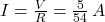
Voltage across 22Ω resistor:
Closest option:Answer:2VIncorrect
Total resistance
Current
Voltage across 22Ω resistor:
Closest option:Answer:2VUnattempted
Total resistance
Current
Voltage across 22Ω resistor:
Closest option:Answer:2V -
Question 84 of 120
84. Question
1 pointsCategory: Polycet PhysicsOf the two bulbs in a house, one glows brighter than the other, which of the two has larger resistance?
Correct
Brighter bulb consumes more power ⇒ for same voltage,
 ⇒ smaller resistance.
So, dim bulb has larger resistance.
Answer:Dim bulbIncorrect
Brighter bulb consumes more power ⇒ for same voltage,
⇒ smaller resistance.
So, dim bulb has larger resistance.
Answer:Dim bulbUnattempted
Brighter bulb consumes more power ⇒ for same voltage,
⇒ smaller resistance.
So, dim bulb has larger resistance.
Answer:Dim bulb -
Question 85 of 120
85. Question
1 pointsCategory: Polycet PhysicsPick the correct answer from the following two statements:
(A) Kirchhoff’s junction law is based on the conservation of charge.
(B) Kirchhoff’s loop law is based on the conversation of energy.Correct
(A) Kirchhoff’s junction law → conservation of charge
(B) Kirchhoff’s loop law → conservation of energy
Answer:Both A and B are trueIncorrect
(A) Kirchhoff’s junction law → conservation of charge
(B) Kirchhoff’s loop law → conservation of energy
Answer:Both A and B are trueUnattempted
(A) Kirchhoff’s junction law → conservation of charge
(B) Kirchhoff’s loop law → conservation of energy
Answer:Both A and B are true -
Question 86 of 120
86. Question
1 pointsCategory: Polycet PhysicsThe electric power (in kWh) consumed in operating a 60W bulb for 3 hours a day in a month of 30 days is
Correct
Power = 60 W, time = 3 hrs/day × 30 = 90 hrs
Energy = 60 W × 90 hr = 5400 Wh = 5.4 kWh
Answer:5.4Incorrect
Power = 60 W, time = 3 hrs/day × 30 = 90 hrs
Energy = 60 W × 90 hr = 5400 Wh = 5.4 kWh
Answer:5.4Unattempted
Power = 60 W, time = 3 hrs/day × 30 = 90 hrs
Energy = 60 W × 90 hr = 5400 Wh = 5.4 kWh
Answer:5.4 -
Question 87 of 120
87. Question
1 pointsCategory: Polycet PhysicsOn increasing the temperature, the resistance of copper and germanium respectively
Correct
Copper is a metal → resistance increases with temperature.
Germanium is a semiconductor → resistance decreases with temperature.
Answer:increases, decreasesIncorrect
Copper is a metal → resistance increases with temperature.
Germanium is a semiconductor → resistance decreases with temperature.
Answer:increases, decreasesUnattempted
Copper is a metal → resistance increases with temperature.
Germanium is a semiconductor → resistance decreases with temperature.
Answer:increases, decreases -
Question 88 of 120
88. Question
1 pointsCategory: Polycet Physics3 Volt x 4 coulomb
Correct
Voltage × Charge = Work (Energy):

Answer:12 joulesIncorrect
Voltage × Charge = Work (Energy):
Answer:12 joulesUnattempted
Voltage × Charge = Work (Energy):
Answer:12 joules -
Question 89 of 120
89. Question
1 pointsCategory: Polycet PhysicsThree resistors of 1Ω, 0.1Ω and 0.01Ω are connected in series combination. Their Equivalent resistance is
Correct
To find the equivalent resistance of resistors connected in series, we simply add their resistances together.
Given:
–
–
– *(Note: The question likely meant 0.01Ω, not 0.01Ω, as 0.1Ω is already listed)*
Calculation:


Conclusion:
The equivalent resistance is 1.11,Ω.Incorrect
To find the equivalent resistance of resistors connected in series, we simply add their resistances together.
Given:
–
–
– *(Note: The question likely meant 0.01Ω, not 0.01Ω, as 0.1Ω is already listed)*
Calculation:
Conclusion:
The equivalent resistance is 1.11,Ω.Unattempted
To find the equivalent resistance of resistors connected in series, we simply add their resistances together.
Given:
–
–
– *(Note: The question likely meant 0.01Ω, not 0.01Ω, as 0.1Ω is already listed)*
Calculation:
Conclusion:
The equivalent resistance is 1.11,Ω. -
Question 90 of 120
90. Question
1 pointsCategory: Polycet PhysicsThe scientist who proposed that the metallic conductors contain large number of free electrons is
Correct
Free electron theory of metals proposed by Drude and Lorentz
Answer:Drude and LorentzIncorrect
Free electron theory of metals proposed by Drude and Lorentz
Answer:Drude and LorentzUnattempted
Free electron theory of metals proposed by Drude and Lorentz
Answer:Drude and Lorentz -
Question 91 of 120
91. Question
1 pointsCategory: Polycet ChemistryWhich of the following is not a chemical process?
Correct
Rusting, baking, and acid-base reactions are chemical changes.Changing water into vapor is a physical change (no new substance).
Answer:changing water into water vapourIncorrect
Rusting, baking, and acid-base reactions are chemical changes.Changing water into vapor is a physical change (no new substance).
Answer:changing water into water vapourUnattempted
Rusting, baking, and acid-base reactions are chemical changes.Changing water into vapor is a physical change (no new substance).
Answer:changing water into water vapour -
Question 92 of 120
92. Question
1 pointsCategory: Polycet ChemistryWhat is the value of X in the following balanced equation?
YH2+O2+XH2OCorrect
The balanced equation is:

Let’s assume YH₂ is like H₂ (diatomic) and we balance:
 Incorrect
The balanced equation is:
Let’s assume YH₂ is like H₂ (diatomic) and we balance:
Unattempted
The balanced equation is:
Let’s assume YH₂ is like H₂ (diatomic) and we balance:
-
Question 93 of 120
93. Question
1 pointsCategory: Polycet ChemistryIf Q is the heat energy, determine the nature of the reaction in the following equation: 2C2H6 +702 →4CO2 +6H2O+Q
Correct
Since Q is released, the reaction gives off heat → exothermic.
Incorrect
Since Q is released, the reaction gives off heat → exothermic.
Unattempted
Since Q is released, the reaction gives off heat → exothermic.
-
Question 94 of 120
94. Question
1 pointsCategory: Polycet ChemistryIn the equation given below, 100g of CaCO3 and 73g of HCI are used to prevent 18g of H2O. If 300g of CaCO3 and 146g of HCl are used, then how many grams of H2O is produced?
Correct
Given:
100g CaCO₃ + 73g HCl → 18g H₂O
Scaling up 3× CaCO₃ = 300g and 2× HCl = 146g
Limiting reagent here is HCl (not enough to go 3×)
If 73g HCl gives 18g H₂O → 146g gives 36gIncorrect
Given:
100g CaCO₃ + 73g HCl → 18g H₂O
Scaling up 3× CaCO₃ = 300g and 2× HCl = 146g
Limiting reagent here is HCl (not enough to go 3×)
If 73g HCl gives 18g H₂O → 146g gives 36gUnattempted
Given:
100g CaCO₃ + 73g HCl → 18g H₂O
Scaling up 3× CaCO₃ = 300g and 2× HCl = 146g
Limiting reagent here is HCl (not enough to go 3×)
If 73g HCl gives 18g H₂O → 146g gives 36g -
Question 95 of 120
95. Question
1 pointsCategory: Polycet ChemistryWhich of the following is/are used to detect acidic or basic nature of a solution?
Correct
Phenolphthalein and universal indicator are used to detect pH.Metals do not indicate acidity/basicity.
Answer:All of these *(Note: technically metals don’t detect pH, but likely included here in a broad sense)*Incorrect
Phenolphthalein and universal indicator are used to detect pH.Metals do not indicate acidity/basicity.
Answer:All of these *(Note: technically metals don’t detect pH, but likely included here in a broad sense)*Unattempted
Phenolphthalein and universal indicator are used to detect pH.Metals do not indicate acidity/basicity.
Answer:All of these *(Note: technically metals don’t detect pH, but likely included here in a broad sense)* -
Question 96 of 120
96. Question
1 pointsCategory: Polycet ChemistryWhich of the following metal liberates H2 gas on reaction with NaOH
Correct
Zinc (Zn) reacts with NaOH to liberate hydrogen gas:

Answer:ZnIncorrect
Zinc (Zn) reacts with NaOH to liberate hydrogen gas:
Answer:ZnUnattempted
Zinc (Zn) reacts with NaOH to liberate hydrogen gas:
Answer:Zn -
Question 97 of 120
97. Question
1 pointsCategory: Polycet ChemistryWhich of the following can’t be used as X in the equation given below?
Acid+X → Salt + CO2 + waterCorrect
The correct answer is D. Metal hydroxides.
Explanation:
The given reaction is:

Let’s analyze each option:
– 1. A. Metal hydrogen carbonates (e.g., NaHCO₃)
– Reaction:

– Valid, as this produces .
.
– 2. B. Metal carbonates (e.g., Na₂CO₃)
– Reaction:

– Valid, as this also produces.
– 3. C. Both (1) and (2)
– Since both A and B are valid, this option is incorrect for the question (which asks for what can’t be used).
– 4. D. Metal hydroxides (e.g., NaOH)
– Reaction:

– Does not produce.
– Hence, this is the correct answer because it cannot be used to produce.
Conclusion:
Only metal hydroxides (D) do not produce when reacting with acids, making them the correct choice for what can’t be used in the given reaction.Incorrect
The correct answer is D. Metal hydroxides.
Explanation:
The given reaction is:
Let’s analyze each option:
– 1. A. Metal hydrogen carbonates (e.g., NaHCO₃)
– Reaction:
– Valid, as this produces.
– 2. B. Metal carbonates (e.g., Na₂CO₃)
– Reaction:
– Valid, as this also produces.
– 3. C. Both (1) and (2)
– Since both A and B are valid, this option is incorrect for the question (which asks for what can’t be used).
– 4. D. Metal hydroxides (e.g., NaOH)
– Reaction:
– Does not produce.
– Hence, this is the correct answer because it cannot be used to produce.
Conclusion:
Only metal hydroxides (D) do not produce when reacting with acids, making them the correct choice for what can’t be used in the given reaction.Unattempted
The correct answer is D. Metal hydroxides.
Explanation:
The given reaction is:
Let’s analyze each option:
– 1. A. Metal hydrogen carbonates (e.g., NaHCO₃)
– Reaction:
– Valid, as this produces.
– 2. B. Metal carbonates (e.g., Na₂CO₃)
– Reaction:
– Valid, as this also produces.
– 3. C. Both (1) and (2)
– Since both A and B are valid, this option is incorrect for the question (which asks for what can’t be used).
– 4. D. Metal hydroxides (e.g., NaOH)
– Reaction:
– Does not produce.
– Hence, this is the correct answer because it cannot be used to produce.
Conclusion:
Only metal hydroxides (D) do not produce when reacting with acids, making them the correct choice for what can’t be used in the given reaction. -
Question 98 of 120
98. Question
1 pointsCategory: Polycet ChemistryTooth enamel is made up with
Correct
Tooth enamel is made of calcium phosphate (hard mineral in teeth).
Answer:calcium phosphateIncorrect
Tooth enamel is made of calcium phosphate (hard mineral in teeth).
Answer:calcium phosphateUnattempted
Tooth enamel is made of calcium phosphate (hard mineral in teeth).
Answer:calcium phosphate -
Question 99 of 120
99. Question
1 pointsCategory: Polycet ChemistryWhat is the pH of the salt formed from weak acid and strong base?
Correct
Weak acid + strong base → basic salt → pH > 7, typically \~9
Answer:9Incorrect
Weak acid + strong base → basic salt → pH > 7, typically \~9
Answer:9Unattempted
Weak acid + strong base → basic salt → pH > 7, typically \~9
Answer:9 -
Question 100 of 120
100. Question
1 pointsCategory: Polycet ChemistryWho among the following did not propose atomic model?
Correct
Planck proposed quantum theory (energy quanta), but not an atomic modelOthers proposed atomic structure models
Answer:PlanckIncorrect
Planck proposed quantum theory (energy quanta), but not an atomic modelOthers proposed atomic structure models
Answer:PlanckUnattempted
Planck proposed quantum theory (energy quanta), but not an atomic modelOthers proposed atomic structure models
Answer:Planck -
Question 101 of 120
101. Question
1 pointsCategory: Polycet ChemistryWhich of the following electromagnetic waves has highest velocity?
Correct
All electromagnetic waves travel at the same speed in vacuum (≈ 3×10⁸ m/s).
Answer:All have same velocityIncorrect
All electromagnetic waves travel at the same speed in vacuum (≈ 3×10⁸ m/s).
Answer:All have same velocityUnattempted
All electromagnetic waves travel at the same speed in vacuum (≈ 3×10⁸ m/s).
Answer:All have same velocity -
Question 102 of 120
102. Question
1 pointsCategory: Polycet ChemistryWhich of the following quantum numbers gives information about orientation of orbital?
Correct
Magnetic quantum number (mₗ) describes the orientation of an orbital in space.
Answer:Magnetic quantum numberIncorrect
Magnetic quantum number (mₗ) describes the orientation of an orbital in space.
Answer:Magnetic quantum numberUnattempted
Magnetic quantum number (mₗ) describes the orientation of an orbital in space.
Answer:Magnetic quantum number -
Question 103 of 120
103. Question
1 pointsCategory: Polycet ChemistryThe electronic configuration of element ‘S’ is
Correct
Element ‘S’ (sulfur) has atomic number 16.
Its electron configuration:

Answer:1s² 2s² 2p⁶ 3s² 3p⁴Incorrect
Element ‘S’ (sulfur) has atomic number 16.
Its electron configuration:
Answer:1s² 2s² 2p⁶ 3s² 3p⁴Unattempted
Element ‘S’ (sulfur) has atomic number 16.
Its electron configuration:
Answer:1s² 2s² 2p⁶ 3s² 3p⁴ -
Question 104 of 120
104. Question
1 pointsCategory: Polycet ChemistryThe maximum number of electrons that can be accommodated in a subshell with angular momentum quantum number 1 is
Correct
For angular momentum quantum number l = 1 (i.e. p-subshell), number of orbitals =
 ,
,
Each orbital holds 2 electrons → total =
Answer:2(2l + 1)Incorrect
For angular momentum quantum number l = 1 (i.e. p-subshell), number of orbitals =
,
Each orbital holds 2 electrons → total =
Answer:2(2l + 1)Unattempted
For angular momentum quantum number l = 1 (i.e. p-subshell), number of orbitals =
,
Each orbital holds 2 electrons → total =
Answer:2(2l + 1) -
Question 105 of 120
105. Question
1 pointsCategory: Polycet ChemistryWhich among the following is a non- metal?
Correct
Among the options, Chlorine is the only non-metal.
Answer:ChlorineIncorrect
Among the options, Chlorine is the only non-metal.
Answer:ChlorineUnattempted
Among the options, Chlorine is the only non-metal.
Answer:Chlorine -
Question 106 of 120
106. Question
1 pointsCategory: Polycet ChemistryWhich of the following periodic classification is not based on the atomic weights of elements?
Correct
Modern periodic table is based on atomic number, not atomic weight.
Answer:Modern periodic tableIncorrect
Modern periodic table is based on atomic number, not atomic weight.
Answer:Modern periodic tableUnattempted
Modern periodic table is based on atomic number, not atomic weight.
Answer:Modern periodic table -
Question 107 of 120
107. Question
1 pointsCategory: Polycet ChemistryAn element with atomic number 14 has a valency of
Correct
Atomic number 14 → Silicon (Si) → configuration: 2, 8, 4 ⇒ valency = 4
Answer:4Incorrect
Atomic number 14 → Silicon (Si) → configuration: 2, 8, 4 ⇒ valency = 4
Answer:4Unattempted
Atomic number 14 → Silicon (Si) → configuration: 2, 8, 4 ⇒ valency = 4
Answer:4 -
Question 108 of 120
108. Question
1 pointsCategory: Polycet ChemistryWhat is the family name of VII A group elements?
Correct
Group VIIA elements (F, Cl, Br, etc.) are known as halogens.
Answer:HalogensIncorrect
Group VIIA elements (F, Cl, Br, etc.) are known as halogens.
Answer:HalogensUnattempted
Group VIIA elements (F, Cl, Br, etc.) are known as halogens.
Answer:Halogens -
Question 109 of 120
109. Question
1 pointsCategory: Polycet ChemistryWhich type of bond is formed due to transfer of electrons between two dissimilar atoms?
Correct
Ionic (electrovalent) bond forms by transfer of electrons between atoms of different electronegativity. All given terms refer to this.
Answer:All of theseIncorrect
Ionic (electrovalent) bond forms by transfer of electrons between atoms of different electronegativity. All given terms refer to this.
Answer:All of theseUnattempted
Ionic (electrovalent) bond forms by transfer of electrons between atoms of different electronegativity. All given terms refer to this.
Answer:All of these -
Question 110 of 120
110. Question
1 pointsCategory: Polycet ChemistryWhich of the following is correct regarding the melting points of ionic, polar covalent and non-polar covalent compounds?
Correct
Ionic > Polar covalent > Non-polar covalent in terms of melting point, due to strong electrostatic forces in ionic compounds.
Answer:Ionic > Polar covalent > non-polar covalentIncorrect
Ionic > Polar covalent > Non-polar covalent in terms of melting point, due to strong electrostatic forces in ionic compounds.
Answer:Ionic > Polar covalent > non-polar covalentUnattempted
Ionic > Polar covalent > Non-polar covalent in terms of melting point, due to strong electrostatic forces in ionic compounds.
Answer:Ionic > Polar covalent > non-polar covalent -
Question 111 of 120
111. Question
1 pointsCategory: Polycet ChemistryWhat is the hybridization in H2O molecule?
Correct
Water (H₂O) has two lone pairs on oxygen, leading to a bent shape.
The hybridization is sp³ (4 electron domains around oxygen).
Answer:sp³Incorrect
Water (H₂O) has two lone pairs on oxygen, leading to a bent shape.
The hybridization is sp³ (4 electron domains around oxygen).
Answer:sp³Unattempted
Water (H₂O) has two lone pairs on oxygen, leading to a bent shape.
The hybridization is sp³ (4 electron domains around oxygen).
Answer:sp³ -
Question 112 of 120
112. Question
1 pointsCategory: Polycet ChemistryWhich among the following theories explained both shape and strength of the bond in covalent compounds?
Correct
Valence Bond Theory (VBT) explains both bond strength and shape via orbital overlap.
Answer:Valence bond theoryIncorrect
Valence Bond Theory (VBT) explains both bond strength and shape via orbital overlap.
Answer:Valence bond theoryUnattempted
Valence Bond Theory (VBT) explains both bond strength and shape via orbital overlap.
Answer:Valence bond theory -
Question 113 of 120
113. Question
1 pointsCategory: Polycet ChemistryHighest abundant metal in earth’s crust is
Correct
The most abundant metal in Earth’s crust is aluminium (Al).
Answer:AlIncorrect
The most abundant metal in Earth’s crust is aluminium (Al).
Answer:AlUnattempted
The most abundant metal in Earth’s crust is aluminium (Al).
Answer:Al -
Question 114 of 120
114. Question
1 pointsCategory: Polycet ChemistryWhich of the following is not a sulphide ore?
Correct
Pyrolusite (MnO₂) is an oxide ore, not a sulphide.
Answer:PyrolusiteIncorrect
Pyrolusite (MnO₂) is an oxide ore, not a sulphide.
Answer:PyrolusiteUnattempted
Pyrolusite (MnO₂) is an oxide ore, not a sulphide.
Answer:Pyrolusite -
Question 115 of 120
115. Question
1 pointsCategory: Polycet ChemistryWhich of the following ores undergoes roasting?
Correct
Roasting is mainly used for sulphide ores, converting them into oxides.
Answer:Sulphide oresIncorrect
Roasting is mainly used for sulphide ores, converting them into oxides.
Answer:Sulphide oresUnattempted
Roasting is mainly used for sulphide ores, converting them into oxides.
Answer:Sulphide ores -
Question 116 of 120
116. Question
1 pointsCategory: Polycet ChemistryWhich of the following metals liberates H2 on reaction with steam but not with cold water?
Correct
Iron (Fe) reacts with steam, but not with cold water, producing H₂ gas.
Answer:FeIncorrect
Iron (Fe) reacts with steam, but not with cold water, producing H₂ gas.
Answer:FeUnattempted
Iron (Fe) reacts with steam, but not with cold water, producing H₂ gas.
Answer:Fe -
Question 117 of 120
117. Question
1 pointsCategory: Polycet ChemistryThe numbers of sigma (σ) and pi (π) bonds in C2H2 molecule is
Correct
In ethyne (C₂H₂):
Each carbon forms 1 σ-bond with H and 1 σ-bond between C–CBetween C≡C, 1 σ + 2 π bonds
→ Total: 3 σ and 2 π bonds
Answer:3 sigma and 2 piIncorrect
In ethyne (C₂H₂):
Each carbon forms 1 σ-bond with H and 1 σ-bond between C–CBetween C≡C, 1 σ + 2 π bonds
→ Total: 3 σ and 2 π bonds
Answer:3 sigma and 2 piUnattempted
In ethyne (C₂H₂):
Each carbon forms 1 σ-bond with H and 1 σ-bond between C–CBetween C≡C, 1 σ + 2 π bonds
→ Total: 3 σ and 2 π bonds
Answer:3 sigma and 2 pi -
Question 118 of 120
118. Question
1 pointsCategory: Polycet ChemistryWhich of the following is not a conductor?
Correct
Diamond is a poor conductor (all electrons are bonded), unlike graphite and nanotubes.
Answer:DiamondIncorrect
Diamond is a poor conductor (all electrons are bonded), unlike graphite and nanotubes.
Answer:DiamondUnattempted
Diamond is a poor conductor (all electrons are bonded), unlike graphite and nanotubes.
Answer:Diamond -
Question 119 of 120
119. Question
1 pointsCategory: Polycet ChemistryWhich of the following is an unsaturated hydrocarbon?
Correct
Butyne contains a triple bond ⇒ unsaturated hydrocarbon.
Answer:ButyneIncorrect
Butyne contains a triple bond ⇒ unsaturated hydrocarbon.
Answer:ButyneUnattempted
Butyne contains a triple bond ⇒ unsaturated hydrocarbon.
Answer:Butyne -
Question 120 of 120
120. Question
1 pointsCategory: Polycet ChemistryWhat does an oxidizing agent do?
Correct
An oxidizing agent causes oxidation of another substance and itself gets reduced.
Answer:It oxidizes other substance and itself undergoes reductionIncorrect
An oxidizing agent causes oxidation of another substance and itself gets reduced.
Answer:It oxidizes other substance and itself undergoes reductionUnattempted
An oxidizing agent causes oxidation of another substance and itself gets reduced.
Answer:It oxidizes other substance and itself undergoes reduction
TS Polycet(polytechnic) EXAM PATTERN AND SYLLABUS:
1) The examination (POLYCET) will be of 2 Hrs 30 Minutes duration consisting of only one
paper as per the syllabus in the subjects of Mathematics, Physics, Chemistry & Biology
of X Class (S.S.C.) Examination held in Academic Year 2020-2021 as prescribed by the
Board of Secondary Education, Telangana State.
2) The POLYCET Examination will be conducted for 150 marks in
Mathematics (60 marks) +
Physics (30 Marks) +
Chemistry (30 Marks) +
Biology (30 Marks).
3) The Duration of Examination is 2 ½ hours.
4) The candidates who are willing to take admission in to Agricultural & Veterinary Diploma
Courses offered by PJTSAU & PVNRTVU attempt Biology Questions.
5) The Question Paper Pattern will be:
| Subjects | No. of Questions | Marks |
| Physics | 30 | 30 |
| Chemistry | 30 | 30 |
| Mathematics | 60 | 60 |
| Biology | 30 | 30 |
| Total | 150 | 150 |
No negative marks for wrong answers.
TS Polycet SYLLABUS FOR COMMON ENTRANCE TEST:
The Syllabus of Mathematics, Physics, Chemistry and Biology for POLYCET-2021 is the same as that of SSC Examination for the A.Y 2020-21 conducted by the Board of Secondary Education, Telangana.
Syllabus of Mathematics:
- Real Numbers
- Number System
- Sets
- Polynomials
- Algebra
- Progressions
- Quadratic Equations
- Linear Equations
- Geometry
- Coordinate Geometry
- Surface Areas & Volume
- Trigonometry
- Mensuration
- Probability
- Statistics
- Mathematical Modeling
Syllabus of Physics:
- A structure of Atom
- Chemical Bonding
- Carbon & its Compounds
- Heat
- Classification of Elements
- Magnetic Effects of Electric Current
- Chemical Equations & Reactions
- Acids, Bases & Salts
- Refraction of Light at Plane Surface
- Refraction of Light at Curved Surface
- Human Eye & Colorful World
- Electricity
- Metallurgy
- Reflection of Light
Syllabus of Chemistry:
- The States of Matter
- Surface Chemistry
- Electrochemistry
- Redox Reactions
- Polymers
- Nuclear Chemistry
- Chemical and Ionic Equilibrium
- Phase equilibrium & Solutions
- Chemical Thermodynamics
- Basic Concepts in Organic Chemistry and Stereochemistry
- Organic compounds with the functional group containing nitrogen
- Chemical Kinetics
- Atomic Structure
- Chemistry in everyday life
- Urea and malonic ester
- Qualitative and quantitative analysis and purification of organic compounds
- Preparation, Properties, and Reactions of Alkanes, Alkenes, Alkynes
- Organic compounds with the functional group containing oxygen
- Reactions of Benzene and heterocyclic compounds
- Organic compounds with the functional group containing halogens
- Biomolecules – Carbohydrates, Protein, Vitamins, Nucleic Acid, Lipids, Hormones Reactions of a, b unsaturated carbonyl and acids
- Spectroscopy measurements including IR, UV, NMR (proton and carbon 13)
- Environmental Chemistry, etc.
Syllabus of Biology:
1. Nutrition
2. Respiration
3. Transportation
4. Excretion
5. Coordination
6. Reproduction
7. Coordination in life process
8. Heredity
9. Our environment
10. Natural resources
1. As POLYCET tests are separately being conducted by the State of Telangana and Andhra Pradesh, the candidates of Telangana intending to take admission in the courses offered in State wide institutions of Andhra Pradesh State, in the ratio of 42:36:22 in AU/OU/SVU regions, or desirous of seeking admission under 15% ‘unreserved’ quota offered in Andhra Pradesh State, shall appear for POLYCET-2021 conducted by the State of Andhra Pradesh.
2. The seats in various Diploma courses of PJTSAU will be filled up by PJTSAU based on the ranks obtained in the POLYCET 2021. The University will give separate counseling and admission notifications. The interested candidates need to apply for the Diploma courses offered by PJTSAU.
3. The seats in various Diploma courses of PVNRTVU will be filled up by PVNRTVU based on the ranks obtained in the POLYCET 2021. The University will give separate counseling and admission notifications. The interested candidates need to apply for the Diploma courses offered by PVNRTVU.
4. 6 years integrated (2+4) undergraduate (B.Tech.) courses offered by Rajiv Gandhi University of Knowledge Technologies (RGUKT), Basar, Nirmal Dist, Telangana for AY-2022-23.
Leaderboard: Polycet Mock Test 10 - 2022 AP
| Pos. | Name | Entered on | Points | Result |
|---|---|---|---|---|
| Table is loading | ||||
| No data available | ||||