AP Polycet (Polytechnic) 2025 Previous Question Paper with Answers And Model Papers With Complete Analysis

41)Each one of 100 boxes is filled with 50 one-rupee coins on the first day and 25 more coins are added every next day. The Arithmetic Progression (AP) representing this situation is

A) 100, 50, 25, 10, …

B) 50, 25, 25, 25, …

C) 50, 75, 100, 125, …

D) 50, 25, 75, 100, …

View Answer

C) 50, 75, 100, 125, …
Explanation:Starts with 50 and increases by 25 → AP: 50, 75, 100, 125…
→ 50, 75, 100, 125, …
42)Common difference of the AP 3, 1, -1, -3, … is

A) 1

B) -2

C) -1

D) 2

View Answer

B) -2
Explanation:1 – 3 = -2
→ common difference = B. -2
43)Tenth term of the AP 1, -1, -3, -5, … is

A) -15

B) -17

C) -13

D) -10

View Answer

B) -17
Explanation:a = 1, d = -2 → 10th term = a + (10 – 1)d = 1 + 9(–2) = –17
→ -17
44)The sum of the first 22 terms of the AP 8, 3, -2, … is

A) -979

B) 979

C) 1028

D) -1028

View Answer

A) -979
Explanation:a = 8, d = -5 →
Sum = \frac{n}{2} [2a + (n - 1)d] = \frac{22}{2} [16 + 21(-5)] = 11(16 - 105) = 11(-89) = -979
→ -979
45)D and E are the midpoints of sides AB and AC of a triangle ABC respectively and BC = 10 cm. If DE ∥ BC, then the length of DE is

A) 3 cm

B) 5 cm

C) 4 cm

D) 6 cm

View Answer

B) 5 cm
Explanation:DE ∥ BC and D, E midpoints → DE = ½ BC = ½ × 10 = B. 5 cm
46)Which of the following are not similar figures?

A) Circles

B) Squares

C) Isosceles triangles

D) Equilateral triangles

View Answer

C) Isosceles triangles
Explanation:Isosceles triangles are not always similar
→ Isosceles triangles
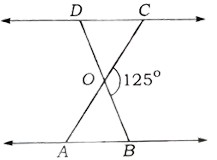
47)If △ODC ∼△OBA and ∠BOC =125◦,then ∠DOC = ?
A) 60°

B) 55°

C) 50°

D) 65°

View Answer

B) 55°
Explanation:△ODC ∼ △OBA, so ∠DOC = ∠BOC = 125° (but in triangle ODC, angle should be < 90°, so it must be the matching corresponding angle). Since ∠BOC = 125°, ∠DOC is corresponding to ∠BOA = 180° – 125° = 55°
→ 55°
48)If M\left(\frac{p}{3}, 4\right) is the midpoint of the line segment joining A(-6, 5) and B(-4, 3), then p = ?

A) -10

B) -8

C) -9

D) -15

View Answer

D) -15
Explanation:Midpoint of A(-6, 5) and B(-4, 3):
Midpoint = \left( \frac{-6 + (-4)}{2}, \frac{5 + 3}{2} \right) = (-5, 4) \Rightarrow \frac{p}{3} = -5 \Rightarrow p = -15

→ -15
49)The distance between the points (2, 3) and (4, 1) is

A) 2√2

B) 2

C) √2

D) 2√3

View Answer

A) 2√2
Explanation:Distance = \sqrt{(4-2)^2 + (1-3)^2} = \sqrt{4 + 4} = \sqrt{8} = 2\sqrt{2}

→ 2√2
50)The coordinates of the point P(x, y) which divides the line segment joining the points A(x_1, y_1) and B(x_2, y_2) internally in the ratio m_1 : m_2 are

A) \left( \frac{m_1 x_1 + m_2 x_2}{m_1 + m_2}, \frac{m_1 y_1 + m_2 y_2}{m_1 + m_2} \right)

B) \left( \frac{m_1 x_2 + m_2 x_1}{m_1 + m_2}, \frac{m_1 y_2 + m_2 y_1}{m_1 + m_2} \right)

C) \left( \frac{m_1 x_2 - m_2 x_1}{m_1 + m_2}, \frac{m_1 y_2 - m_2 y_1}{m_1 + m_2} \right)

D) \left( \frac{m_1 x_2 - m_2 x_1}{m_1 - m_2}, \frac{m_1 y_2 - m_2 y_1}{m_1 - m_2} \right)

View Answer

A) \left( \frac{m_1 x_1 + m_2 x_2}{m_1 + m_2}, \frac{m_1 y_1 + m_2 y_2}{m_1 + m_2} \right)
Explanation:Internal division formula:
\left( \frac{m_1 x_2 + m_2 x_1}{m_1 + m_2}, \frac{m_1 y_2 + m_2 y_1}{m_1 + m_2} \right)
Your Score: 0 / 0
Spread the love

Leave a Comment

MCQBits provides free online MCQ practice tests for competitive exams, school exams, and entrance tests in India. Practice chapter-wise multiple choice questions, previous year papers, and mock tests with answers to improve your exam performance.
Prepare for TSPSC, APPSC, TS Polycet, CBSE Class 10, SSC,UPSC, RRB and other government exams with regularly updated quizzes and important questions.
About Us | Contact Us | Privacy Polocy
error: Content is protected !!



