TS Polycet (Polytechnic) 2021 Previous Question Paper with Answers And Model Papers With Complete Analysis

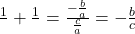
11)If α,β are the roots of a quadratic equation ax2+bx+c=0, a≠0 then \frac1\alpha+\frac1\beta = ……..

A) -\frac ba

B) \frac ca

C) -\frac bc

D) \frac bc

View Answer

C) -\frac bc
Explanation:We are given that α and β are roots of the quadratic equation: ax<sup>2</sup> + bx + c = 0, a ≠ 0 We need to find the value of:\frac{1}{α} + \frac{1}{β} Shortcut Trick:\frac{1}{α} + \frac{1}{β} = \frac{α + β}{α β} From the standard formulas for a quadratic:α + β = -\frac{b}{a}α β = \frac{c}{a} So,\frac{1}{α} + \frac{1}{β} = \frac{-\frac{b}{a}}{\frac{c}{a}} = -\frac{b}{c} Final Answer:-\frac{b}{c} Want a similar shortcut forα^2 + β^2? [/su_spoiler] </div>  <div class="mcq-question" data-answer="C"> <b>12)10th term of an arithmetic progression 2,-1,-4,...... is</b> <div class="mcq-options"> A) -21 B) -23 C) -25 D) -27 </div> [su_spoiler title="View Answer" style="fancy" icon="arrow"] C) -25 Explanation:We are given the arithmetic progression: 2,-1,-4,... Step 1: Identify first term and common difference First term a = 2 Common difference d = -1 - 2 = -3 Step 2: Use formula for nth term of AP: T<sub>n</sub> = a + (n-1)d For the 10th term: TT<sub>10</sub> = 2 + (10-1)(-3) = 2 + 9(-3) = 2 - 27 = -25 [/su_spoiler] </div>  <div class="mcq-question" data-answer="D"> <b>13)How many two digit numbers are divisible by 7?</b> <div class="mcq-options"> A) 10 B) 11 C) 12 D) 13 </div> [su_spoiler title="View Answer" style="fancy" icon="arrow"] D) 13 Explanation:To find how many two-digit numbers are divisible by 7, follow this shortcut method: Step 1: Two-digit numbers range from 10 to 99. Step 2: Find the first two-digit number divisible by 7:\lceil \frac{10}{7} \rceil = 2 ⇒ 2 × 7 = 14 Step 3: Find the last two-digit number divisible by 7:\lfloor \frac{99}{7} \rfloor = 14 ⇒ 14 × 7 = 98 Step 4: Use AP count formula:\text{Count} = \frac{(98 – 14)}{7} + 1 = \frac{84}{7} + 1 = 12 + 1 = 13[/su_spoiler] </div>  <div class="mcq-question" data-answer="B"> <b>14)The sum of 15 terms of A.P. 3, 6, 9......</b> <div class="mcq-options"> A) 315 B) 360 C) 415 D) 460 </div> [su_spoiler title="View Answer" style="fancy" icon="arrow"] B) 360 Explanation:We are given an A.P.:3, 6, 9, ... This is a common A.P. where: First terma = 3Common difference d = 6 - 3 = 3 Number of terms n = 15 Use shortcut formula for sum of n terms of A.P.:S_n = \frac{n}{2} [2a + (n – 1)d] Plug in values:S_{15} = \frac{15}{2} [2(3) + (15 – 1)(3)] = \frac{15}{2} [6 + 42] = \frac{15}{2} × 48 = 15 × 24 = 360[/su_spoiler] </div>  <div class="mcq-question" data-answer="C"> <b>15)The value of x which satisfies the equation 2x-(4-x)=5-x is</b> <div class="mcq-options"> A) 4.5 B) 3 C) 2.25 D) 0.5 </div> [su_spoiler title="View Answer" style="fancy" icon="arrow"] C) 2.25 Explanation:Solve: 2x - (4 - x) = 5 - x Simplify LHS: 2x - 4 + x = 5 - x ⇒ 3x - 4 = 5 - x Bring all terms to one side: 3x + x = 5 + 4 ⇒ 4x = 9 ⇒ x =\frac{9}{4} = 2.25 [/su_spoiler] </div>  <div class="mcq-question" data-answer="A"> <b>16)Solution of the equations 3x-4y=7 and 2x+3y=-1 is not equal to ......</b> <div class="mcq-options"> A)\frac{22}{22},\frac{33}{33} B)\frac{33}{33},-\frac{44}{44} C)\frac{44}{44},-\frac{77}{77} D)\frac{77}{77},-\frac{11}{11} </div> [su_spoiler title="View Answer" style="fancy" icon="arrow"] A)\frac{22}{22},\frac{33}{33}Explanation:Eliminate incorrect solution: You are given equations: ⇒1. 3x - 4y = 7 ⇒2. 2x + 3y = -1 Now test the options by substituting values. ⇒A.x = \frac{22}{22} = 1, y = \frac{33}{33} = 1 1st:3(1) – 4(1) = 3 – 4 = -1 ≠ 7 So, this is incorrect. Correct Answer:\frac{22}{22}, \frac{33}{33} (does notsatisfy the equations) [/su_spoiler] </div>  <div class="mcq-question" data-answer="A"> <b>17)If Σn = 45, then n= ......</b> <div class="mcq-options"> A) 9 B) 10 C) 11 D) 12 </div> [su_spoiler title="View Answer" style="fancy" icon="arrow"] A) 9 Explanation:If Σn = 45, then n = ? We assume this means the sum of first n natural numbers:\sum n = \frac{n(n+1)}{2} = 45
⇒ n(n+1) = 90 Try n = 9: 9 × 10 = 90 [/su_spoiler] </div>  <div class="mcq-question" data-answer="B"> <b>18)The centre of a circle with (1, 2) and (7,-4) as end points of the diameter is</b> <div class="mcq-options"> A) (-4,1) B) (4,-1) C) (-4,-1) D) (4,1) </div> [su_spoiler title="View Answer" style="fancy" icon="arrow"] B) (4,-1) Explanation:Midpoint of diameter endpoints (1, 2) and (7, -4) Use midpoint formula:\left( \frac{1 + 7}{2}, \frac{2 + (-4)}{2} \right) = \left( \frac{8}{2}, \frac{-2}{2} \right) = (4, -1) Correct Answer: (4, -1) [/su_spoiler] </div>  <div class="mcq-question" data-answer="A"> <b>19)Area of a triangle formed by the line xcosα+ysinα=p with the coordinate axes</b> <div class="mcq-options"> A)\frac{P^2}{2\sin\left(\alpha\right)\cos\left(\alpha\right)} B)\frac{P^2}{\sin\left(\alpha\right)\cos\left(\alpha\right)} C)\frac P{2\sin\left(\alpha\right)\cos\left(\alpha\right)} D)\frac P{\sin\left(\alpha\right)\cos\left(\alpha\right)} </div> [su_spoiler title="View Answer" style="fancy" icon="arrow"] A)\frac{P^2}{2\sin\left(\alpha\right)\cos\left(\alpha\right)}Explanation:Area of triangle formed by line with axes Equation: xcosα + ysinα = p Find x- and y-intercepts: Put y = 0:x = \frac{p}{\cosα} Put x = 0:y = \frac{p}{\sinα} Area of triangle =\frac{1}{2} \cdot \frac{p}{\cosα} \cdot \frac{p}{\sinα} = \frac{p^2}{2\sinα\cosα} Correct Answer:\frac{P^2}{2\sinα\cosα}$
20)If x+7y=7 and 7x-3y=-3, then y =

A) 1

B) 7

C) -3

D) 0

View Answer

A) 1
Explanation:Solve:
1) } x + 7y = 7
2) } 7x – 3y = -3
From (1):x = 7 – 7y
Substitute into (2):
7(7 – 7y) – 3y = -3
49 – 49y – 3y = -3 ⇒ -52y = -52 ⇒ y = 1
Your Score: 0 / 0
Spread the love

Leave a Comment

MCQBits provides free online MCQ practice tests for competitive exams, school exams, and entrance tests in India. Practice chapter-wise multiple choice questions, previous year papers, and mock tests with answers to improve your exam performance.
Prepare for TSPSC, APPSC, TS Polycet, CBSE Class 10, SSC,UPSC, RRB and other government exams with regularly updated quizzes and important questions.
About Us | Contact Us | Privacy Polocy
error: Content is protected !!