D) Resistivity-1
Explanation:Conductivity = D. Resistivity-1
(Conductivity (σ) is the reciprocal of resistivity (ρ), i.e., ( ).)
82) Least distance of distinct vision is ……
A) 25 m
B) 25 mm
C) 25 cm
D) 25 km
View Answer
C) 25 cm
Explanation:Least distance of distinct vision is …… 25 cm
(The least distance of distinct vision for a normal human eye is about 25 cm, the closest distance at which an object can be seen clearly.)
83) The resistance of human body varies between
A) 100Ω to 50,000Ω
B) 1000Ω to 5,000Ω
C) 1,000 Ω to 5,00,000 Ω
D) 100Ω to 5,00,000Ω
View Answer
D) 100Ω to 5,00,000Ω
Explanation:Human body resistance varies widely depending on conditions: 100Ω to 500,000Ω
Answer: 100Ω to 5,00,000Ω
84) Focal length of a lens is 25 cm. Its power is …….
A) 5D
B) 6D
C) 4D
D) 0.04D
View Answer
C) 4D
Explanation:Focal length of a lens is 25 cm. Its power is ……. 4D
(Power of a lens (P) is given by ( P = ) (in meters). Here, ( f = 0.25 m ), so ( P = = 4 D ).)
85) When a person is suffering from both Myopia and Hypermetropia, which should be used
A) Bi-convex lens
B) Bi-concave lens
C) Bi-focal lens
D) Bi-focal mirror
View Answer
C) Bi-focal lens
Explanation:When a person is suffering from both Myopia and Hypermetropia, which should be used?
Bi-focal lens
(A bi-focal lens has two parts: the upper part corrects myopia (short-sightedness), and the lower part corrects hypermetropia (long-sightedness).)
86) The current in a conductor is directly proportional to the potential difference between its end. This is called ……
A) Faraday's law
B) Kirchoff's laaw
C) Ohm's law
D) Newton's law
View Answer
C) Ohm's law
Explanation:The current in a conductor is directly proportional to the potential difference between its ends. This is called …… Ohm's law
(Ohm's law states ( V = IR ), meaning current (I) is directly proportional to voltage (V) for a constant resistance (R).)
87) When a copper wire is connected to a battery the electric field in the wire is
A) more at positive terminal
B) more at negative terminal
C) not uniform in the wire
D) uniform in the wire
View Answer
D) uniform in the wire
Explanation:When a copper wire is connected to a battery, the electric field in the wire is
uniform in the wire
(In a uniform conductor like copper, the electric field is constant (uniform) along the wire when connected to a steady voltage source.)
88) Units for specific resistance ….
A) Ωm
B) Ω/m
C) m/Ω
D) Ωkg
View Answer
A) Ωm
Explanation:Units for specific resistance ….
Ωm
(Specific resistance (resistivity) has units of ohm-meter (Ωm).)
89) = which quantity
A) Potential
B) Current
C) Resistance
D) Capacity
View Answer
A) Potential
Explanation:( ) = which quantity?
Potential
(Electric potential (V) is defined as work done per unit charge, and since work = force × distance, ( V = ).)
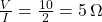
90) A current through a conductor is 2A. When there is a potential difference of 10V between its ends. Its resistance is
A) 5Ω
B) 0.2Ω
C) 20Ω
D) 2.5Ω
View Answer
A) 5Ω
Explanation:A current through a conductor is 2A. When there is a potential difference of 10V between its ends, its resistance is
5Ω
(Using Ohm's law, ( R = ).)
MCQBits provides free online MCQ practice tests for competitive exams, school exams, and entrance tests in India. Practice chapter-wise multiple choice questions, previous year papers, and mock tests with answers to improve your exam performance.
Prepare for TSPSC, APPSC, TS Polycet, CBSE Class 10, SSC,UPSC, RRB and other government exams with regularly updated quizzes and important questions. About Us | Contact Us | Privacy Polocy

 ).)
).) ) (in meters). Here, ( f = 0.25 m ), so ( P =
  = 4 D ).)
 = which quantity
 ) = which quantity?
 ).)
).) ).)
).)