TS Polycet (Polytechnic) 2021 Previous Question Paper with Answers And Model Papers With Complete Analysis

21)Which of the following equation is not a linear equation

A) 2+3x=y-5

B) 3-x=y2+7

C) x+3y=2y-x

D) 5x+2y=0

View Answer

B) 3-x=y2+7
Explanation:Which of the following equations is not a linear equation?
(2 + 3x = y – 5) → Linear(Degree 1)
(3 – x = y2 + 7) → Not linear(Degree 2 in (y))
(x + 3y = 2y – x) → Linear(Degree 1)
(5x + 2y = 0) → Linear(Degree 1)
22)If x2+kx+1=0 has a root x=1 then k =

A) 1

B) 2

C) 3

D) -2

View Answer

D) -2
Explanation:If (x2 + kx + 1 = 0) has a root (x = 1), then (k = ?)
Substitute (x = 1):
12 + k(1) + 1 = 0 ⇒ 1 + k + 1 = 0 ⇒ k = -2
23)If the roots of the quadratic equation ax2 + bx+c=0 are sinα and cosα, then 1+2\frac ca = …….

A) \frac{a^2}{b^2}

B) \frac{b^2}{a^2}

C) a2

D) b2

View Answer

B) \frac{b^2}{a^2}
Explanation:If the roots of (ax^2 + bx + c = 0) are (sin α) and (cos α), then (1 + 2\frac{c}{a} = ?)
Given roots: (sin α + cos α = –\frac{b}{a}) and (sin α cos α = $\frac{c}{a}).
Using the identity:
sin2 α + cos2 α = 1 ⇒ (sin α + cos α)2 – 2 sin α cos α = 1
Substitute:
\[ \left(-\frac{b}{a}\right)^2 – 2\left(\frac{c}{a}\right) = 1 ⇒ \frac{b^2}{a^2} – \frac{2c}{a} = 1 \] Rearrange:
\[ 1 + 2\frac{c}{a} = \frac{b^2}{a^2} \]
24)If the system of equation 3x-2y-7=0 and kx+2y+11=0 has unique solution then …….

A) k≠3

B) k≠-3

C) k=3

D) k=-3

View Answer

B) k≠-3
Explanation:If the system (3x – 2y – 7 = 0) and (kx + 2y + 11 = 0) has a unique solution, then:
For a unique solution, the lines must not be parallel:
\[ \frac{a_1}{a_2} ≠q \frac{b_1}{b_2} ⇒ \frac{3}{k} ≠q \frac{-2}{2} ⇒ \frac{3}{k} ≠q -1 ⇒ k ≠q -3 \]
25)If 7x-5y=2 and 3x+y=4, then x=

A) 3

B) -3

C) 1

D) 2

View Answer

C) 1
Explanation:If (7x – 5y = 2) and (3x + y = 4), then (x = ?)
From the second equation: (y = 4 – 3x).
Substitute into the first equation:
7x – 5(4 – 3x) = 2
⇒ 7x – 20 + 15x = 2
⇒ 22x = 22
⇒ x = 1
26)The distance between the points (0, 0) and (5,12) is

A) 11

B) 12

C) 13

D) 14

View Answer

C) 13
Explanation:Distance between (0, 0) and (5, 12) is:
\[ \sqrt{(5-0)^2 + (12-0)^2} = \sqrt{25 + 144} = \sqrt{169} = 13 \]
27)If the slope of the line through (x,5) and (5,2) is 3, then the value of x is

A) 3

B) 4

C) 5

D) 6

View Answer

D) 6
Explanation:Slope of the line through (x, 5) and (5, 2) is 3. Find (x):
\[ \text{Slope} = \frac{2 – 5}{5 – x} = 3 ⇒ \frac{-3}{5 – x} = 3 ⇒ -3 = 15 – 3x ⇒ x = 6 \]
28)If △ABC~△PQR, ∠A=32°, ∠R=65° then ∠B=

A) 93°

B) 83°

C) 73°

D) 63°

View Answer

B) 83°
Explanation:If (ΔABC ~ ΔPQR), (∠A = 32°), (∠R = 65°), then (∠B = ?)
Corresponding angles are equal, so (∠C = ∠R = 65°).
Sum of angles in (ΔABC):
∠B = 180° – ∠A – ∠C = 180° – 32° – 65° = 83°
29)The angle in the minor segment is

A) obtuse

B) acute

C) 90°

D) None of these

View Answer

A) obtuse
Explanation:The angle in the minor segment is:
An angle in the minor segment is obtuse(greater than (90°).
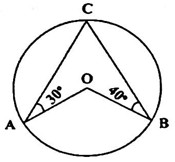
30)In the figure ∠BAO=30°, ∠BCO=40° then ∠AOC=
A) 100°

B) 120°

C) 140°

D) 150°

View Answer

C) 140°
Explanation:In the figure, (∠BAO = 30°), (∠BCO = 40°). Then (∠AOC = ?)
From the figure (assuming (O) is the center of the circle):
– (∠AOC = 2(∠ABC) (Central angle theorem).
– (∠ABC = ∠BAO + ∠BCO = 30° + 40° = 70°).
– Thus, (∠AOC = 2 × 70° = 140°).
Your Score: 0 / 0
Spread the love

Leave a Comment

MCQBits provides free online MCQ practice tests for competitive exams, school exams, and entrance tests in India. Practice chapter-wise multiple choice questions, previous year papers, and mock tests with answers to improve your exam performance.
Prepare for TSPSC, APPSC, TS Polycet, CBSE Class 10, SSC,UPSC, RRB and other government exams with regularly updated quizzes and important questions.
About Us | Contact Us | Privacy Polocy
error: Content is protected !!