
11) If α,β are the roots of a quadratic equation ax2+bx+c=0, a≠0 then  = ……..
A) 
B) 
C) 
D) 
Explanation:We are given that α and β are roots of the quadratic equation:
ax2 + bx + c = 0, a ≠ 0
We need to find the value of:

Shortcut Trick:

From the standard formulas for a quadratic:


So,
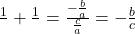
Final Answer: 
12) 10th term of an arithmetic progression 2,-1,-4,…… is
A) -21
B) -23
C) -25
D) -27
13) How many two digit numbers are divisible by 7?
A) 10
B) 11
C) 12
D) 13
Explanation:To find how many two-digit numbers are divisible by 7, follow this shortcut method:
Step 1: Two-digit numbers range from 10 to 99.
Step 2: Find the first two-digit number divisible by 7:

Step 3: Find the last two-digit number divisible by 7:

Step 4: Use AP count formula:

14) The sum of 15 terms of A.P. 3, 6, 9……
A) 315
B) 360
C) 415
D) 460
Explanation:We are given an A.P.:3, 6, 9, …
This is a common A.P. where:
First term  Common difference d = 6 – 3 = 3
Number of terms n = 15
Use shortcut formula for sum of n terms of A.P.:
![S_n = \frac{n}{2} [2a + (n - 1)d]](https://www.mcqbits.com/wp-content/ql-cache/quicklatex.com-763e8973c15a7790089f7c817b809238_l3.png "Rendered by QuickLaTeX.com")
Plug in values:
![S_{15} = \frac{15}{2} [2(3) + (15 - 1)(3)] = \frac{15}{2} [6 + 42] = \frac{15}{2} × 48 = 15 × 24 = 360](https://www.mcqbits.com/wp-content/ql-cache/quicklatex.com-f7c7e77c55b6e672bbab627b32c3f708_l3.png "Rendered by QuickLaTeX.com")
15) The value of x which satisfies the equation 2x-(4-x)=5-x is
A) 4.5
B) 3
C) 2.25
D) 0.5
Explanation:Solve:
2x – (4 – x) = 5 – x
Simplify LHS:
2x – 4 + x = 5 – x ⇒ 3x – 4 = 5 – x
Bring all terms to one side:
3x + x = 5 + 4 ⇒ 4x = 9 ⇒ x =  = 2.25