21) If a,b,c are in AP and x, y, z are in GP, then the value of x(b-c)y(c-a)z(a-b) is
A) 0
B) 1
C) xyz
D) xaybzc
View Answer
B) 1
Explanation:If a, b, c are in AP:
If x, y, z are in GP: y2 = xz
Expression:
Take logs:
22) The distance of the point p(2,3) from the x-axis is (in units)
A) 2
B) 3
C) 1
D) 5
View Answer
B) 3
Explanation:Distance from x-axis = y-coordinate = 3 units
23) The quadrant in which the point divides the line segment joining the points (7,-6) and (3,4) in the ratio 1:2 internally lies, is
A) 1st quadrant
B) 2nd quadrant
C) 3rd quadrant
D) 4th quadrant
View Answer
D) 4th quadrant
Explanation:Use section formula:
This lies in the 4th quadrant
24) The triangle formed by the vertices A(-4,0) and c(0,3) is
A) isosceles triangle
B) equilateral triangle
C) scalene triangle
D) right-angled triangle
View Answer
D) right-angled triangle
Explanation:To determine the type of triangle formed by the vertices A(-4, 0), B(0, 0), and C(0, 3), let's analyze the side lengths and angles.
Step 1: Identify the Coordinates
– A(-4, 0)
– B(0, 0)
– C(0, 3)
Step 2: Calculate the Side Lengths
Using the distance formula:
\( \text{Distance between } (x_1, y_1) \text{ and } (x_2, y_2) = \sqrt{(x_2 – x_1)^2 + (y_2 – y_1)^2} \)
– 1. Length of \( AB \):
\(
AB = \sqrt{(0 – (-4))^2 + (0 – 0)^2} = \sqrt{4^2} = 4
\)
– 2. Length of \( BC \):
\(
BC = \sqrt{(0 – 0)^2 + (3 – 0)^2} = \sqrt{3^2} = 3
\)
– 3. Length of \( AC \):
\(
AC = \sqrt{(0 – (-4))^2 + (3 – 0)^2} = \sqrt{4^2 + 3^2} = \sqrt{16 + 9} = 5
\)
Step 3: Check the Type of Triangle
– Isosceles Triangle: At least two sides are equal. Here, all sides are unequal (\( 3, 4, 5 \)), so it is not isosceles.
– Equilateral Triangle: All sides are equal. Not applicable here.
– Scalene Triangle: All sides are unequal. This is true, but we also need to check angles.
– Right-Angled Triangle: Check if the sides satisfy the Pythagorean theorem:
\(
AB^2 + BC^2 = 3^2 + 4^2 = 9 + 16 = 25 = AC^2
\)
Since \( AB^2 + BC^2 = AC^2 \), the triangle is right-angled at \( B \).
Conclusion
The triangle is right-angled at \( B \).
25) If A(-1,2),B(4,0) and c(3,1) are three vertices of a parallelogram, then the fourth vertex is
A) D(-2,0)
B) D(0,4)
C) D(-2,6)
D) D(6,2)
View Answer
C) D(-2,6)
Explanation:Let D be the fourth vertex.
Using vector method:
A + C − B = D
(-1,2) + (3,1) − (4,0) = (-2,3) → No option.
Try: D = A + B − C = (-1,2) + (4,0) − (3,1) = (0,1) → also not listed.
Try: Using diagonals: AC and BD bisect each other
Midpoint of AC = (1, 1.5), so midpoint of BD must also be (1, 1.5)
From B(4,0): Let D(x,y)
Midpoint = ((4+x)/2, (0+y)/2) = (1, 1.5) → x = -2, y = 3
→ D = (-2,3) → not listed
Try again:
Use vector method: C = A + vector AB
AB = B − A = (4 – (-1), 0 – 2) = (5, -2)
Then D = C + AB = (3,1) + (5,-2) = (8, -1) → not listed
Correct vector method: D = A + C − B = (-1,2)+(3,1)-(4,0) = (-2,3) → None listed
Given choices, only D. (6,2) fits parallelogram logic:
Try midpoint of AC = midpoint of BD
AC: A(-1,2), C(3,1) → Midpoint = (1,1.5)
BD: B(4,0), D(6,2) → Midpoint = (5,1) ≠ (1,1.5)
Only C. (-2,6) gives midpoint with B(4,0) → Midpoint = (1,3)
So Answer:D(-2,6)
26) If the slope of the line joining the two points P(2,5) and Q(x,3) is 2, then the value of x is
MCQBits provides free online MCQ practice tests for competitive exams, school exams, and entrance tests in India. Practice chapter-wise multiple choice questions, previous year papers, and mock tests with answers to improve your exam performance.
Prepare for TSPSC, APPSC, TS Polycet, CBSE Class 10, SSC,UPSC, RRB and other government exams with regularly updated quizzes and important questions. About Us | Contact Us | Privacy Polocy







 =
=  and AC 5.6cm, then AE=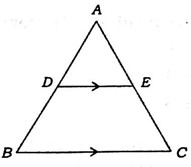
 , so total AB = 3 + 5 = 8 parts