
11)The distance between the points  and is
మరియు బిందువుల మధ్య దూరము కనుగొనుటకు సూత్రము
A)
Explanation:🎯 Shortcut Method to Find the Distance Between Two Points
The distance formula between two points and in a plane is:
Explanation:
– The difference between the x-coordinates is.
– The difference between the y-coordinates is.
– Then, apply the Pythagorean theorem to find the distance.
Final Answer:
 and
and  is మరియు బిందువుల మధ్య దూరము కనుగొనుటకు సూత్రము
A) 
B) 
C) 
D) 
View Answer
A)
Explanation:🎯 Shortcut Method to Find the Distance Between Two Points
The distance formula between two points
 and
and  in a plane is:
Explanation:
– The difference between the x-coordinates is
 .
.– The difference between the y-coordinates is
 .
.– Then, apply the Pythagorean theorem to find the distance.
Final Answer:

12)The coordinates of the point which divides the line segment joining the points (4,-3) and (8, 5) in the ratio 3:1 internally is
బిందువులు (4, −3) మరియు (8, 5) లచే ఏర్పడు రేఖాఖండమును 3:1 నిష్పత్తిలో అంతరంగా విభజించు బిందువు నిరూపకాలు
B) (7,3)
Explanation:🎯 Shortcut Method: Finding Coordinates of a Point Dividing a Line Segment in a Given Ratio
To find the coordinates of a point that divides a line segment joining two points and in the ratio m : n, use the section formula:
Given:
– Point 1: (4, -3)
– Point 2: (8, 5)
– Ratio: 3 : 1
Step 1: Apply the Section Formula
Final Answer:
The coordinates of the point are (7, 3).
బిందువులు (4, −3) మరియు (8, 5) లచే ఏర్పడు రేఖాఖండమును 3:1 నిష్పత్తిలో అంతరంగా విభజించు బిందువు నిరూపకాలు
View Answer
B) (7,3)
Explanation:🎯 Shortcut Method: Finding Coordinates of a Point Dividing a Line Segment in a Given Ratio
To find the coordinates of a point that divides a line segment joining two points
and in the ratio m : n, use the section formula:
Given:
– Point 1: (4, -3)
– Point 2: (8, 5)
– Ratio: 3 : 1
Step 1: Apply the Section Formula


Final Answer:
The coordinates of the point are (7, 3).

13)Which of the following is not a formula for arithmetic mean?
ఈ క్రింది వానిలో అంకగణిత సగటునకు సూత్రము కానిది ఏది?
D)
Explanation:🎯 Shortcut Method for Identifying the Formula for Arithmetic Mean
We are asked to identify which of the following is NOT a formula for the arithmetic mean.
Let’s quickly review each option:
– 1.
This is the weighted mean formula. It is a standard formula for the arithmetic mean when you have data with frequencies. Correct formula.
– 2.
This formula is used for grouped data where is the assumed mean, and is the deviation of values from the assumed mean. Correct formula.
– 3.
This is another formula for grouped data. Here, is the deviation from the actual mean, and is the class width. Correct formula.
– 4.
This formula is used to calculate the mode in grouped data, not the mean. Incorrect formula for arithmetic mean.
Conclusion:
The formula for the mode is in Option 4. Therefore, the correct answer is:
This is NOT a formula for the arithmetic mean; it is for the mode.
ఈ క్రింది వానిలో అంకగణిత సగటునకు సూత్రము కానిది ఏది?
A) 
B) 
C) ![a+\left[\frac{\Sigma f_i\mu_i}{\Sigma f_i}\right]\times h](https://www.mcqbits.com/wp-content/ql-cache/quicklatex.com-bb73fd3b181ad875cd053255c04e0758_l3.png "Rendered by QuickLaTeX.com")
D) ![l+\left[\frac{f_1-f_0}{2f_1\;-\;f_0\;-\;f_2}\right]\times h](https://www.mcqbits.com/wp-content/ql-cache/quicklatex.com-dfa0b83b4f3e019bf0cdad6698b38eb9_l3.png "Rendered by QuickLaTeX.com")
View Answer
D)
Explanation:🎯 Shortcut Method for Identifying the Formula for Arithmetic Mean
We are asked to identify which of the following is NOT a formula for the arithmetic mean.
Let’s quickly review each option:
– 1.

This is the weighted mean formula. It is a standard formula for the arithmetic mean when you have data with frequencies. Correct formula.
– 2.

This formula is used for grouped data where
 is the assumed mean, and
  is the deviation of values from the assumed mean. Correct formula.
– 3.
![a + \left[ \frac{\Sigma f_i \mu_i}{\Sigma f_i} \right] \times h](https://www.mcqbits.com/wp-content/ql-cache/quicklatex.com-f665f360394c9af5acc57dec898db64e_l3.png "Rendered by QuickLaTeX.com")
This is another formula for grouped data. Here,
 is the deviation from the actual mean, and
  is the class width. Correct formula.
– 4.
![l + \left[ \frac{f_1 - f_0}{2f_1 - f_0 - f_2} \right] \times h](https://www.mcqbits.com/wp-content/ql-cache/quicklatex.com-892635ded12efba61ade828c0b21135a_l3.png "Rendered by QuickLaTeX.com")
This formula is used to calculate the mode in grouped data, not the mean. Incorrect formula for arithmetic mean.
Conclusion:
The formula for the mode is in Option 4. Therefore, the correct answer is:
![\boxed{4. \, l + \left[\frac{f_1 - f_0}{2f_1 - f_0 - f_2}\right] \times h}](https://www.mcqbits.com/wp-content/ql-cache/quicklatex.com-9cb81115c38fc1802acc204c8acd5e93_l3.png "Rendered by QuickLaTeX.com")
This is NOT a formula for the arithmetic mean; it is for the mode.
14)Rain fall of a town in a week is 4 cm, 5 cm, 12 cm, 3 cm, 6 cm, 8 cm and 4 cm, then the average rainfall per day is
ఒక వారములో ఒక పట్టణపు వర్షపాతం 4 సెం.మీ., 5 సెం.మీ., 12 సెం.మీ., 3 సెం.మీ., 6 సెం.మీ., 8 సెం.మీ. మరియు 4 సెం.మీ. అయిన, ఒక రోజులో సరాసరి వర్షపాతము
C) 6 cm
Explanation:🎯 Shortcut Method for Finding the Average Rainfall per Day
To find the average rainfall per day, we use the formula for the arithmetic mean:
Given rainfall for the week:
– 4 cm, 5 cm, 12 cm, 3 cm, 6 cm, 8 cm, and 4 cm.
Step 1: Calculate the total rainfall
Step 2: Divide the total rainfall by the number of days (7 days in a week)
Final Answer:
ఒక వారములో ఒక పట్టణపు వర్షపాతం 4 సెం.మీ., 5 సెం.మీ., 12 సెం.మీ., 3 సెం.మీ., 6 సెం.మీ., 8 సెం.మీ. మరియు 4 సెం.మీ. అయిన, ఒక రోజులో సరాసరి వర్షపాతము
View Answer
C) 6 cm
Explanation:🎯 Shortcut Method for Finding the Average Rainfall per Day
To find the average rainfall per day, we use the formula for the arithmetic mean:

Given rainfall for the week:
– 4 cm, 5 cm, 12 cm, 3 cm, 6 cm, 8 cm, and 4 cm.
Step 1: Calculate the total rainfall

Step 2: Divide the total rainfall by the number of days (7 days in a week)

Final Answer:

15)Mode of the data 9, 10, 19, 7, 11, 5, 6, 7, 8, 14, 10, 7, 6 is
9, 10, 19, 7, 11, 5, 6, 7, 8, 14, 10, 7, 6 అనే దత్తాంశం యొక్క బాహుళకము
B) 7
Explanation:🎯 Shortcut Method for Finding the Mode
The mode of a dataset is the value that appears most frequently. Let’s go through the steps to find the mode.
Given data:
9, 10, 19, 7, 11, 5, 6, 7, 8, 14, 10, 7, 6
Step 1: Count the frequency of each number
– 9 appears 1 time
– 10 appears 2 times
– 19 appears 1 time
– 7 appears 3 times
– 11 appears 1 time
– 5 appears 1 time
– 6 appears 2 times
– 8 appears 1 time
– 14 appears 1 time
Step 2: Identify the number with the highest frequency
– The number 7 appears 3 times, which is the highest frequency.
Final Answer:
9, 10, 19, 7, 11, 5, 6, 7, 8, 14, 10, 7, 6 అనే దత్తాంశం యొక్క బాహుళకము
View Answer
B) 7
Explanation:🎯 Shortcut Method for Finding the Mode
The mode of a dataset is the value that appears most frequently. Let’s go through the steps to find the mode.
Given data:
9, 10, 19, 7, 11, 5, 6, 7, 8, 14, 10, 7, 6
Step 1: Count the frequency of each number
– 9 appears 1 time
– 10 appears 2 times
– 19 appears 1 time
– 7 appears 3 times
– 11 appears 1 time
– 5 appears 1 time
– 6 appears 2 times
– 8 appears 1 time
– 14 appears 1 time
Step 2: Identify the number with the highest frequency
– The number 7 appears 3 times, which is the highest frequency.
Final Answer:

16)If A, B and C are interior angles of triangle ABC, then the value of is
A, B మరియు C లు త్రిభుజం ABC లోని అంతర కోణాలైన, యొక్క విలువ
C)
Explanation:🎯 Shortcut Method for the Given Expression:
We are given that, , and are the interior angles of a triangle, i.e., .
We need to find the value of:
Step 1: Use the fact that
Since the sum of the angles in a triangle is, we can substitute . Thus,
Step 2: Use the cosine of a difference
Now we have:
Using the co-function identity:
We get:
Final Answer:
This is the quickest method using the fact that the sum of the angles in a triangle is and applying trigonometric identities.
 is
isA, B మరియు C లు త్రిభుజం ABC లోని అంతర కోణాలైన,
యొక్క విలువ
A) 
B) 
C) 
D) 
View Answer
C)
Explanation:🎯 Shortcut Method for the Given Expression:
We are given that
 ,
,  , and
, and  are the interior angles of a triangle, i.e.,
  .
.We need to find the value of:

Step 1: Use the fact that
Since the sum of the angles in a triangle is
 , we can substitute
  . Thus,
Step 2: Use the cosine of a difference
Now we have:
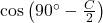
Using the co-function identity:

We get:

Final Answer:

This is the quickest method using the fact that the sum of the angles in a triangle is
and applying trigonometric identities.17)The value of cos 54° cos 36° – sin 54° sin 36° is
cos 54° cos 36° – sin 54° sin 36° యొక్క విలువ
A) 0
Explanation:🎯 Shortcut Method for Solving
The expression is a well-known cosine identity:
Step 1: Apply the cosine addition formula
Using the identity, we can rewrite the given expression as:
Step 2: Simplify
We know that:
Final Answer:
cos 54° cos 36° – sin 54° sin 36° యొక్క విలువ
A) 0
B) 1
C) 
D) 
View Answer
A) 0
Explanation:🎯 Shortcut Method for Solving

The expression
 is a well-known cosine identity:
Step 1: Apply the cosine addition formula
Using the identity
, we can rewrite the given expression as:
Step 2: Simplify
We know that:

Final Answer:

18)Which of the following rational number have terminating decimal?
కింది వాటిలో ఏ అకరణీయ సంఖ్య అంతమయ్యే దశాంశాన్ని కలిగి ఉంటుంది?
A)
Explanation:🎯 Shortcut Method to Determine if a Rational Number Has a Terminating Decimal
A rational number has a terminating decimal if and only if, when simplified, its denominator has no prime factors other than 2 and 5. In other words, the denominator of the fraction must be of the form, where and are non-negative integers.
Let’s check each option:
– 1.
– The denominator is 250, which factors as:
– Since the denominator contains only the primes 2 and 5, this fraction will have a terminating decimal.
– 2.
– The denominator is 225, which factors as:
– Since 225 has a factor of 3, it does not meet the condition for a terminating decimal.
– 3.
– The denominator is 18, which factors as:
– Since 18 has a factor of 3, it does not meet the condition for a terminating decimal.
– 4.
– The denominator is 21, which factors as:
– Since 21 has a factor of 3, it does not meet the condition for a terminating decimal.
Final Answer:
కింది వాటిలో ఏ అకరణీయ సంఖ్య అంతమయ్యే దశాంశాన్ని కలిగి ఉంటుంది?
A) 
B) 
C) 
D) 
View Answer
A)
Explanation:🎯 Shortcut Method to Determine if a Rational Number Has a Terminating Decimal
A rational number has a terminating decimal if and only if, when simplified, its denominator has no prime factors other than 2 and 5. In other words, the denominator of the fraction must be of the form
 , where
  and
and  are non-negative integers.
Let’s check each option:
– 1.

– The denominator is 250, which factors as:
 – Since the denominator contains only the primes 2 and 5, this fraction will have a terminating decimal.
– 2.
– The denominator is 225, which factors as:
 – Since 225 has a factor of 3, it does not meet the condition for a terminating decimal.
– 3.

– The denominator is 18, which factors as:
 – Since 18 has a factor of 3, it does not meet the condition for a terminating decimal.
– 4.

– The denominator is 21, which factors as:
 – Since 21 has a factor of 3, it does not meet the condition for a terminating decimal.
Final Answer:

19)H.C.F. of 2023, 2024, 2025 is –
View Answer
D) 1
Explanation:🎯 Shortcut Method to Find the HCF of 2023, 2024, and 2025
The HCF (Highest Common Factor) of three numbers is the largest number that divides all of them exactly.
Step 1: Check the divisibility of 2023, 2024, and 2025
– The numbers 2023, 2024, and 2025 are consecutive numbers, which means:
– 2024 is one more than 2023, and one less than 2025.
– Consecutive numbers always have an HCF of 1, because there is no number greater than 1 that can divide all three.
Step 2: Conclude the HCF
Since these are consecutive numbers, their HCF is 1.
Final Answer:

20)A boy observed the top of an electric pole at an angle of elevation of 60° when the observation point is 6 meters away from the.foot of the pole, then the height of the pole is
ఒక బాలుడు ఒక విద్యుత్ స్థంభం అడుగు భాగం నుండి 6 మీ. దూరంలో ఉన్న బిందువు నుండి విద్యుత్ స్థంభం పై భాగాన్ని 60° ఊర్ధ్వ కోణంతో పరిశీలించిన, ఆ స్థంభం ఎత్తు
C)
Explanation:🎯 Shortcut Method Using Trigonometry (Tangent)
We are given the following information:
– The angle of elevation to the top of the electric pole is.
– The distance from the observation point to the foot of the pole is 6 meters.
To find the height of the pole, we can use the tangent of the angle of elevation. The tangent function is given by:
In this case:
–
– The distance from the pole = 6 meters
– We need to find the height of the pole.
So,
Since, we have:
Step 2: Solve for the height of the pole
Multiplying both sides by 6:
Thus, the height of the pole is:
Final Answer:
ఒక బాలుడు ఒక విద్యుత్ స్థంభం అడుగు భాగం నుండి 6 మీ. దూరంలో ఉన్న బిందువు నుండి విద్యుత్ స్థంభం పై భాగాన్ని 60° ఊర్ధ్వ కోణంతో పరిశీలించిన, ఆ స్థంభం ఎత్తు
A) 6 m
B) 
C) 
D) 
View Answer
C)
Explanation:🎯 Shortcut Method Using Trigonometry (Tangent)
We are given the following information:
– The angle of elevation to the top of the electric pole is
 .
.– The distance from the observation point to the foot of the pole is 6 meters.
To find the height of the pole, we can use the tangent of the angle of elevation. The tangent function is given by:

In this case:
–

– The distance from the pole = 6 meters
– We need to find the height of the pole.
So,

Since
 , we have:
Step 2: Solve for the height of the pole
Multiplying both sides by 6:

Thus, the height of the pole is:

Final Answer:

Your Score: 0 / 0