
11) The distance between the points  and
and  is మరియు బిందువుల మధ్య దూరము కనుగొనుటకు సూత్రము
A)
B)
C)
D)
and is మరియు బిందువుల మధ్య దూరము కనుగొనుటకు సూత్రముA)
B)
C)
D)
View Answer
A) A
Explanation:Shortcut Method to Find the Distance Between Two Points
The distance formula between two points
 and
and  in a plane is:
Explanation:
– The difference between the x-coordinates is
 .
.– The difference between the y-coordinates is
 .
.– Then, apply the Pythagorean theorem to find the distance.
Final Answer:

12) The coordinates of the point which divides the line segment joining the points (4,-3) and (8, 5) in the ratio 3:1 internally is బిందువులు (4, −3) మరియు (8, 5) లచే ఏర్పడు రేఖాఖండమును 3:1 నిష్పత్తిలో అంతరంగా విభజించు బిందువు నిరూపకాలు
View Answer
B) (7,3)
Explanation:Shortcut Method: Finding Coordinates of a Point Dividing a Line Segment in a Given Ratio
To find the coordinates of a point that divides a line segment joining two points
and in the ratio m : n, use the section formula:
Given:
– Point 1: (4, -3)
– Point 2: (8, 5)
– Ratio: 3 : 1
Step 1: Apply the Section Formula


Final Answer:
The coordinates of the point are (7, 3).

13) Which of the following is not a formula for arithmetic mean? ఈ క్రింది వానిలో అంకగణిత సగటునకు సూత్రము కానిది ఏది?
A)
B)
C)![a+\left[\frac{\Sigma f_i\mu_i}{\Sigma f_i}\right]\times h](https://www.mcqbits.com/wp-content/ql-cache/quicklatex.com-bb73fd3b181ad875cd053255c04e0758_l3.png "Rendered by QuickLaTeX.com")
D)![l+\left[\frac{f_1-f_0}{2f_1\;-\;f_0\;-\;f_2}\right]\times h](https://www.mcqbits.com/wp-content/ql-cache/quicklatex.com-dfa0b83b4f3e019bf0cdad6698b38eb9_l3.png "Rendered by QuickLaTeX.com")
A)
B)
C)
D)
View Answer
D) D
Explanation:Shortcut Method for Identifying the Formula for Arithmetic Mean
We are asked to identify which of the following is NOT a formula for the arithmetic mean.
Let’s quickly review each option:
– 1.

This is the weighted mean formula. It is a standard formula for the arithmetic mean when you have data with frequencies. Correct formula.
– 2.

This formula is used for grouped data where
 is the assumed mean, and
  is the deviation of values from the assumed mean. Correct formula.
– 3.
![a + \left[ \frac{\Sigma f_i \mu_i}{\Sigma f_i} \right] \times h](https://www.mcqbits.com/wp-content/ql-cache/quicklatex.com-f665f360394c9af5acc57dec898db64e_l3.png "Rendered by QuickLaTeX.com")
This is another formula for grouped data. Here,
 is the deviation from the actual mean, and
  is the class width. Correct formula.
– 4.
![l + \left[ \frac{f_1 - f_0}{2f_1 - f_0 - f_2} \right] \times h](https://www.mcqbits.com/wp-content/ql-cache/quicklatex.com-892635ded12efba61ade828c0b21135a_l3.png "Rendered by QuickLaTeX.com")
This formula is used to calculate the mode in grouped data, not the mean. Incorrect formula for arithmetic mean.
Conclusion:
The formula for the mode is in Option 4. Therefore, the correct answer is:
![\boxed{4. \, l + \left[\frac{f_1 - f_0}{2f_1 - f_0 - f_2}\right] \times h}](https://www.mcqbits.com/wp-content/ql-cache/quicklatex.com-9cb81115c38fc1802acc204c8acd5e93_l3.png "Rendered by QuickLaTeX.com")
This is NOT a formula for the arithmetic mean; it is for the mode.
14) Rain fall of a town in a week is 4 cm, 5 cm, 12 cm, 3 cm, 6 cm, 8 cm and 4 cm, then the average rainfall per day is ఒక వారములో ఒక పట్టణపు వర్షపాతం 4 సెం.మీ., 5 సెం.మీ., 12 సెం.మీ., 3 సెం.మీ., 6 సెం.మీ., 8 సెం.మీ. మరియు 4 సెం.మీ. అయిన, ఒక రోజులో సరాసరి వర్షపాతము
View Answer
C) 6 cm
Explanation:Shortcut Method for Finding the Average Rainfall per Day
To find the average rainfall per day, we use the formula for the arithmetic mean:

Given rainfall for the week:
– 4 cm, 5 cm, 12 cm, 3 cm, 6 cm, 8 cm, and 4 cm.
Step 1: Calculate the total rainfall

Step 2: Divide the total rainfall by the number of days (7 days in a week)

Final Answer:

15) Mode of the data 9, 10, 19, 7, 11, 5, 6, 7, 8, 14, 10, 7, 6 is 9, 10, 19, 7, 11, 5, 6, 7, 8, 14, 10, 7, 6 అనే దత్తాంశం యొక్క బాహుళకము
View Answer
B) 7
Explanation:Shortcut Method for Finding the Mode
The mode of a dataset is the value that appears most frequently. Let’s go through the steps to find the mode.
Given data:
9, 10, 19, 7, 11, 5, 6, 7, 8, 14, 10, 7, 6
Step 1: Count the frequency of each number
– 9 appears 1 time
– 10 appears 2 times
– 19 appears 1 time
– 7 appears 3 times
– 11 appears 1 time
– 5 appears 1 time
– 6 appears 2 times
– 8 appears 1 time
– 14 appears 1 time
Step 2: Identify the number with the highest frequency
– The number 7 appears 3 times, which is the highest frequency.
Final Answer:

16) If A, B and C are interior angles of triangle ABC, then the value of  is A, B మరియు C లు త్రిభుజం ABC లోని అంతర కోణాలైన, యొక్క విలువ
A)
B)
C)
D)
is A, B మరియు C లు త్రిభుజం ABC లోని అంతర కోణాలైన, యొక్క విలువA)
B)
C)
D)
View Answer
C) C
Explanation:Shortcut Method for the Given Expression:
We are given that
 ,
,  , and
, and  are the interior angles of a triangle, i.e.,
  .
.We need to find the value of:

Step 1: Use the fact that
Since the sum of the angles in a triangle is
 , we can substitute
  . Thus,
Step 2: Use the cosine of a difference
Now we have:
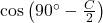
Using the co-function identity:

We get:

Final Answer:

This is the quickest method using the fact that the sum of the angles in a triangle is
and applying trigonometric identities.17) The value of cos 54° cos 36° – sin 54° sin 36° is cos 54° cos 36° – sin 54° sin 36° యొక్క విలువ
A)0
B)1
C)
D)
A)0
B)1
C)
D)
View Answer
A) A
Explanation:Shortcut Method for Solving

The expression
 is a well-known cosine identity:
Step 1: Apply the cosine addition formula
Using the identity
, we can rewrite the given expression as:
Step 2: Simplify
We know that:

Final Answer:

18) Which of the following rational number have terminating decimal? కింది వాటిలో ఏ అకరణీయ సంఖ్య అంతమయ్యే దశాంశాన్ని కలిగి ఉంటుంది?
A)
B)
C)
D)
A)
B)
C)
D)
View Answer
A) A
Explanation:Shortcut Method to Determine if a Rational Number Has a Terminating Decimal
A rational number has a terminating decimal if and only if, when simplified, its denominator has no prime factors other than 2 and 5. In other words, the denominator of the fraction must be of the form
 , where
  and
and  are non-negative integers.
Let’s check each option:
– 1.

– The denominator is 250, which factors as:
 – Since the denominator contains only the primes 2 and 5, this fraction will have a terminating decimal.
– 2.
– The denominator is 225, which factors as:
 – Since 225 has a factor of 3, it does not meet the condition for a terminating decimal.
– 3.

– The denominator is 18, which factors as:
 – Since 18 has a factor of 3, it does not meet the condition for a terminating decimal.
– 4.

– The denominator is 21, which factors as:
 – Since 21 has a factor of 3, it does not meet the condition for a terminating decimal.
Final Answer:

19) H.C.F. of 2023, 2024, 2025 is –
2023, 2024, 2025 ల యొక్క గ.సా.భా.
2023, 2024, 2025 ల యొక్క గ.సా.భా.
View Answer
D) 1
Explanation:Shortcut Method to Find the HCF of 2023, 2024, and 2025
The HCF (Highest Common Factor) of three numbers is the largest number that divides all of them exactly.
Step 1: Check the divisibility of 2023, 2024, and 2025
– The numbers 2023, 2024, and 2025 are consecutive numbers, which means:
– 2024 is one more than 2023, and one less than 2025.
– Consecutive numbers always have an HCF of 1, because there is no number greater than 1 that can divide all three.
Step 2: Conclude the HCF
Since these are consecutive numbers, their HCF is 1.
Final Answer:

20) A boy observed the top of an electric pole at an angle of elevation of 60° when the observation point is 6 meters away from the.foot of the pole, then the height of the pole is ఒక బాలుడు ఒక విద్యుత్ స్థంభం అడుగు భాగం నుండి 6 మీ. దూరంలో ఉన్న బిందువు నుండి విద్యుత్ స్థంభం పై భాగాన్ని 60° ఊర్ధ్వ కోణంతో పరిశీలించిన, ఆ స్థంభం ఎత్తు
A)6 m
B)
C)
D)
A)6 m
B)
C)
D)
View Answer
C) C
Explanation:Shortcut Method Using Trigonometry (Tangent)
We are given the following information:
– The angle of elevation to the top of the electric pole is
 .
.– The distance from the observation point to the foot of the pole is 6 meters.
To find the height of the pole, we can use the tangent of the angle of elevation. The tangent function is given by:

In this case:
–

– The distance from the pole = 6 meters
– We need to find the height of the pole.
So,

Since
 , we have:
Step 2: Solve for the height of the pole
Multiplying both sides by 6:

Thus, the height of the pole is:

Final Answer:

Your Score: 0 / 0