
41)There are exactly _____ tangents to a circle through a point outside the circle.
వృత్త బాహ్యంలో గల ఏదైనా బిందువు గుండా వృత్తానికి ఖచ్చితంగా _____ స్పర్శరేఖలు గీయగలము.
వృత్త బాహ్యంలో గల ఏదైనా బిందువు గుండా వృత్తానికి ఖచ్చితంగా _____ స్పర్శరేఖలు గీయగలము.
42)The length of the tangent from a point 15 cm away from the centre of a circle of radius 9 cm is ____.
9 సెం.మీ. వ్యాసార్ధముగా గల వృత్తానికి దాని కేంద్రం నుండి 15 సెం.మీ. దూరములో ఒక బిందువు కలదు. అయిన, ఆ బిందువు నుండి వృత్తానికి గీయబడిన స్పర్శరేఖ పొడవు ______.
D) 12 cm
Explanation:To find the length of the tangent from a point outside the circle, we can use the Pythagorean Theorem.
Given:
– The distance from the point to the center of the circle (the hypotenuse of the right triangle) = 15 cm.
– The radius of the circle (one leg of the right triangle) = 9 cm.
We need to find the length of the tangent, which is the other leg of the right triangle.
Using the Pythagorean theorem:

Substitute the values:
9 సెం.మీ. వ్యాసార్ధముగా గల వృత్తానికి దాని కేంద్రం నుండి 15 సెం.మీ. దూరములో ఒక బిందువు కలదు. అయిన, ఆ బిందువు నుండి వృత్తానికి గీయబడిన స్పర్శరేఖ పొడవు ______.
View Answer
D) 12 cm
Explanation:To find the length of the tangent from a point outside the circle, we can use the Pythagorean Theorem.
Given:
– The distance from the point to the center of the circle (the hypotenuse of the right triangle) = 15 cm.
– The radius of the circle (one leg of the right triangle) = 9 cm.
We need to find the length of the tangent, which is the other leg of the right triangle.
Using the Pythagorean theorem:

Substitute the values:
*** QuickLaTeX cannot compile formula:
15^2 = 9^2 + \text{(length of the tangent)}^2<span class="ql-right-eqno">   </span><span class="ql-left-eqno">   </span><img src="https://www.mcqbits.com/wp-content/ql-cache/quicklatex.com-90adcfb5a78f5ebddacbc5a89297bf71_l3.png" height="22" width="273" class="ql-img-displayed-equation quicklatex-auto-format" alt="\[225 = 81 + \text{(length of the tangent)}^2\]" title="Rendered by QuickLaTeX.com"/>\text{(length of the tangent)}^2 = 225 - 81 = 144<pre class="ql-errors">*** QuickLaTeX cannot compile formula:
\[\text{length of the tangent} = \sqrt{144} = 12 \, \text{cm}$
Final Answer:
The length of the tangent is 12 cm. So, the correct option is 4. 12 cm.
[/su_spoiler]
</div>
<div class="mcq-question" data-answer="D"><b>43)If the areas of two similar triangles are 81 cm<sup>2</sup> and 49 cm<sup>2</sup> respectively. If the altitude of the smaller triangle is 3.5 cm, then the corresponding altitude of the bigger triangle Is _____
రెండు సరూప త్రిభుజాల వైశాల్యలు 81 చ.సెం.మీ. మరియు 49 చ.సెం.మీ. చిన్న త్రిభుజములో గీసిన లంబము పొడవు 3.5 సెం.మీ. అయిన, పెద్ద త్రిభుజములో దాని అనురూప లంబము పొడవు ____</b>
<div class="mcq-options">
A) 9.5 cm
B) 9 cm
C) 7 cm
D) 4.5 cm
</div>
[su_spoiler title="View Answer" style="fancy" icon="arrow"]
D) 4.5 cm
Explanation:Given:
- Areas of two similar triangles = 81 cm² and 49 cm²
- Altitude of the smaller triangle = 3.5 cm
Formula:
For two similar triangles, the ratio of their areas is the square of the ratio of their corresponding sides (or altitudes).
$\frac{\text{Area of larger triangle}}{\text{Area of smaller triangle}} = \left(\frac{\text{Corresponding side of larger triangle}}{\text{Corresponding side of smaller triangle}}\right)^2$
Step 1: Find the ratio of the areas$\frac{81}{49} = \left(\frac{\text{Altitude of larger triangle}}{\text{Altitude of smaller triangle}}\right)^2\]
*** Error message:
Display math should end with $$.
leading text: ...he tangent} = \sqrt{144} = 12 \, \text{cm}$
Missing $ inserted.
leading text: [/su_
Missing { inserted.
leading text: ...ding altitude of the bigger triangle Is __
Missing { inserted.
leading text: ...ing altitude of the bigger triangle Is ___
Missing { inserted.
leading text: ...ng altitude of the bigger triangle Is ____
Missing { inserted.
leading text: ...g altitude of the bigger triangle Is _____
Missing { inserted.
leading text: ర
Unicode character ర (U+0C30)
leading text: ర
Unicode character ె (U+0C46)
leading text: రె
Unicode character ం (U+0C02)
leading text: రెం
Unicode character డ (U+0C21)
leading text: రెండ
Unicode character ు (U+0C41)
leading text: రెండు
</pre>\left(\frac{\text{Altitude of larger triangle}}{\text{Altitude of smaller triangle}}\right)^2 = \frac{81}{49} = \left(\frac{9}{7}\right)^2<span class="ql-right-eqno">   </span><span class="ql-left-eqno">   </span><img src="https://www.mcqbits.com/wp-content/ql-cache/quicklatex.com-4c73d4e2b7525168c50c120b6ae077ef_l3.png" height="137" width="584" class="ql-img-displayed-equation quicklatex-auto-format" alt="\[\frac{\text{Altitude of larger triangle}}{\text{Altitude of smaller triangle}} = \frac{9}{7}$ Step 2: Find the altitude of the larger triangle Now, we can calculate the altitude of the larger triangle by multiplying the altitude of the smaller triangle by the ratio of the corresponding sides. $\text{Altitude of larger triangle} = \text{Altitude of smaller triangle} \times \frac{9}{7}\]" title="Rendered by QuickLaTeX.com"/>\text{Altitude of larger triangle} = 3.5 \times \frac{9}{7} = 3.5 \times 1.2857 \approx 4.5 \, \text{cm}

*** Error message:
Missing $ inserted.
leading text: 15^
Bad math environment delimiter.
leading text: ...ed-equation quicklatex-auto-format" alt="\[
Missing \endgroup inserted.
leading text: ...5 = 81 + \text{(length of the tangent)}^2\]
\begin{document} ended by \end{equation*}.
leading text: ...5 = 81 + \text{(length of the tangent)}^2\]
Missing $ inserted.
leading text: ...5 = 81 + \text{(length of the tangent)}^2\]
Extra \endgroup.
leading text: ...5 = 81 + \text{(length of the tangent)}^2\]
Missing $ inserted.
leading text: ...LaTeX.com"/>\text{(length of the tangent)}^
Bad math environment delimiter.
leading text: \[
Missing \endgroup inserted.
leading text: ...he tangent} = \sqrt{144} = 12 \, \text{cm}$
Missing $ inserted.
leading text: [/su_
Missing { inserted.
Final Answer:
The altitude of the larger triangle is 4.5 cm.
44)A tangent to a circle touches it in _____ point(s).
వృత్తానికి గీయబడిన స్పర్శరేఖ దానిని ____ బిందువు(ల) వద్ద స్పృశిస్తుంది.
వృత్తానికి గీయబడిన స్పర్శరేఖ దానిని ____ బిందువు(ల) వద్ద స్పృశిస్తుంది.
45)If AP and AQ are the two tangents to a circle with centre ‘O’, so that , then = ______.
క్రింది పటములో ‘O’ కేంద్రముగా గల వృత్తానికి, AP మరియు AQ లు రెండు స్పర్శరేఖలు మరియు అయిన, = ________.
B) 70°
Explanation:To find the measure of angle given that , we can use the properties of tangents to a circle and the fact that the sum of angles in a quadrilateral is .
Given:
– and are tangents to the circle with center .
–.
Key Properties:
– 1. Tangents are perpendicular to the radius at the point of contact:
– (since is a tangent and is the radius).
– (since is a tangent and is the radius).
– 2. Sum of angles in quadrilateral:
Substituting the known values:
Simplifying:
– 3. Since (tangents from an external point are equal), triangle is isosceles:
However, let’s verify this with a more straightforward approach.
Alternative (Simpler) Approach:
– The angle between two tangents () is related to the angle subtended at the center () by:
Substituting the given value:
Final Answer:
 , then
  = ______.
క్రింది పటములో ‘O’ కేంద్రముగా గల వృత్తానికి, AP మరియు AQ లు రెండు స్పర్శరేఖలు మరియు
అయిన, = ________.View Answer
B) 70°
Explanation:To find the measure of angle
given that  , we can use the properties of tangents to a circle and the fact that the sum of angles in a quadrilateral is
  .
.Given:
–
 and
and  are tangents to the circle with center
  .
.–
.Key Properties:
– 1. Tangents are perpendicular to the radius at the point of contact:
–
 (since is a tangent and
  is the radius).
–
 (since is a tangent and is the radius).
– 2. Sum of angles in quadrilateral
 :
:
Substituting the known values:

Simplifying:

– 3. Since
 (tangents from an external point are equal), triangle
  is isosceles:
However, let’s verify this with a more straightforward approach.
Alternative (Simpler) Approach:
– The angle between two tangents (
) is related to the angle subtended at the center ( ) by:
) by:
Substituting the given value:

Final Answer:

46)If where a1x+b1y+c1=0 and a2x+b2y+c2=0 are two linear equations,
అయ్యేటట్లుగాa1x+b1y+c1=0 మరియు a2x+b2y+c2=0 అనేవి రెండు రేఖీయ సమీ కరణాలైతే, ఆ సమీ కరణాలు
A) have a unique solution
ఏకైక సాధన కలిగి ఉంటాయి
Explanation:Given the two linear equations:
And the condition that.
Solution:
The two equations represent two straight lines in the coordinate plane. The condition means that the lines are not parallel and will intersect at exactly one point.
– When two lines intersect at exactly one point, the system of linear equations has a unique solution.
– This condition rules out the possibility of the lines being parallel (which would mean no solution) or coincident (which would mean infinitely many solutions).
Therefore, the correct answer is:
– 1. Have a unique solution.
 where a1x+b1y+c1=0 and a2x+b2y+c2=0 are two linear equations, అయ్యేటట్లుగాa1x+b1y+c1=0 మరియు a2x+b2y+c2=0 అనేవి రెండు రేఖీయ సమీ కరణాలైతే, ఆ సమీ కరణాలు
View Answer
A) have a unique solution
ఏకైక సాధన కలిగి ఉంటాయి
Explanation:Given the two linear equations:

And the condition that
 .
.Solution:
The two equations represent two straight lines in the coordinate plane. The condition
means that the lines are not parallel and will intersect at exactly one point.– When two lines intersect at exactly one point, the system of linear equations has a unique solution.
– This condition rules out the possibility of the lines being parallel (which would mean no solution) or coincident (which would mean infinitely many solutions).
Therefore, the correct answer is:
– 1. Have a unique solution.
47)The value of p, for which the pair of equations 3x+4y+2=0 and 9x+ py+8=0 represents parallel lines, is
3x +4y+ 2 = 0 మరియు 9x + py + 8 = 0 అను సమీకరణాల జత సమాంతర రేఖలను సూచించిన, P విలువ
D) 12
Explanation:To determine the value of for which the pair of equations represents parallel lines, we first examine the general condition for parallel lines.
Given equations:
– 1.
– 2.
Step 1: Write the equations in slope-intercept form, where is the slope.
For the first equation 3x + 4y + 2 = 0, solve for:
3x +4y+ 2 = 0 మరియు 9x + py + 8 = 0 అను సమీకరణాల జత సమాంతర రేఖలను సూచించిన, P విలువ
View Answer
D) 12
Explanation:To determine the value of
 for which the pair of equations represents parallel lines, we first examine the general condition for parallel lines.
Given equations:
– 1.

– 2.

Step 1: Write the equations in slope-intercept form
 , where
  is the slope.
For the first equation 3x + 4y + 2 = 0, solve for
 :
:
![4y = -3x - 2<span class="ql-right-eqno"> </span><span class="ql-left-eqno"> </span><img src="https://www.mcqbits.com/wp-content/ql-cache/quicklatex.com-3bdc84e9d578fdf8b9194fae0629966b_l3.png" height="89" width="582" class="ql-img-displayed-equation quicklatex-auto-format" alt="\[y = -\frac{3}{4}x - \frac{1}{2}$So, the slope $ m_1 $ of the first line is $ -\frac{3}{4} $. For the second equation $ 9x + py + 8 = 0 $, solve for $ y $:$py = -9x - 8\]" title="Rendered by QuickLaTeX.com"/>y = -\frac{9}{p}x - \frac{8}{p}](https://www.mcqbits.com/wp-content/ql-cache/quicklatex.com-bf0c536f4670b697e142bd33dcc7a43d_l3.png "Rendered by QuickLaTeX.com")
So, the slope  of the second line is
  .
.
Step 2: Condition for parallel lines
For the lines to be parallel, their slopes must be equal, i.e.,
![m_1 = m_2<span class="ql-right-eqno"> </span><span class="ql-left-eqno"> </span><img src="https://www.mcqbits.com/wp-content/ql-cache/quicklatex.com-b13b8b66b6b6bf70949bd31755026aa0_l3.png" height="68" width="328" class="ql-img-displayed-equation quicklatex-auto-format" alt="\[-\frac{3}{4} = -\frac{9}{p}$ Step 3: Solve for $ p\]" title="Rendered by QuickLaTeX.com"/>\frac{3}{4} = \frac{9}{p}](https://www.mcqbits.com/wp-content/ql-cache/quicklatex.com-d1e618b5a2b447d4855faa574ee2d9c5_l3.png "Rendered by QuickLaTeX.com")
Cross multiply:
*** QuickLaTeX cannot compile formula:
3p = 36<pre class="ql-errors">*** QuickLaTeX cannot compile formula:
\[p = 12$
Therefore, the value of $ p $ is 12.
The correct answer is:4. 12.
[/su_spoiler]
</div>
<div class="mcq-question" data-answer="B"><b>48)Which of the following equation represent the situation where Kiran bought 5 oranges, 7 apples and Harish bought 2 oranges, 12 apples for same amount of total money?
కిరణ్ 5 నారింజలు, 7 యాపిల్స్ మరియు హరీశ్ 2 నారింజలు, 12 యాపిల్స్ విడివిడిగా ఒకే మొత్తానికి కొన్నారు. కింది సమీకరణాలలో ఈ విషయాన్ని సూచించే సమీకరణము ఏది?</b>
<div class="mcq-options">
A) 5x+12y=2x+7y
B) 5x+7y=2x+12y
C) 5x-7y=2x-12y
D) 5x+2y=7x+12y
</div>
[su_spoiler title="View Answer" style="fancy" icon="arrow"]
B) 5x+7y=2x+12y
Explanation:Let's denote:
- $ x $ as the price of one orange.
- $ y $ as the price of one apple.
Given:
- Kiran bought 5 oranges and 7 apples.
- Harish bought 2 oranges and 12 apples.
- They spent the same amount of money.
Thus, the total money spent by Kiran is:$5x + 7y$And the total money spent by Harish is:$2x + 12y$
Since they spent the same amount, we can set these two expressions equal to each other:$5x + 7y = 2x + 12y$
Simplifying the equation:$5x - 2x = 12y - 7y\]
*** Error message:
Display math should end with $$.
leading text: \[p = 12$
Missing $ inserted.
leading text: [/su_
Unicode character క (U+0C15)
leading text: క
Unicode character ి (U+0C3F)
leading text: కి
Unicode character ర (U+0C30)
leading text: కిర
Unicode character ణ (U+0C23)
leading text: కిరణ
Unicode character ్ (U+0C4D)
leading text: కిరణ్
Unicode character న (U+0C28)
leading text: కిరణ్ 5 న
Unicode character ా (U+0C3E)
leading text: కిరణ్ 5 నా
Unicode character ర (U+0C30)
leading text: కిరణ్ 5 నార
Unicode character ి (U+0C3F)
leading text: కిరణ్ 5 నారి
Unicode character ం (U+0C02)
leading text: కిరణ్ 5 నారిం
Unicode character జ (U+0C1C)
</pre>3x = 5y

*** Error message:
Display math should end with $$.
leading text: \[p = 12$
Missing $ inserted.
leading text: [/su_
Unicode character క (U+0C15)
leading text: క
Unicode character ి (U+0C3F)
leading text: కి
Unicode character ర (U+0C30)
leading text: కిర
Unicode character ణ (U+0C23)
leading text: కిరణ
Unicode character ్ (U+0C4D)
leading text: కిరణ్
Unicode character న (U+0C28)
leading text: కిరణ్ 5 న
Unicode character ా (U+0C3E)
leading text: కిరణ్ 5 నా
Unicode character ర (U+0C30)
leading text: కిరణ్ 5 నార
Unicode character ి (U+0C3F)
leading text: కిరణ్ 5 నారి
Unicode character ం (U+0C02)
leading text: కిరణ్ 5 నారిం
Unicode character జ (U+0C1C)
This is the correct equation representing the given situation.
Therefore, the correct answer is:
2.  .
.
49)If and , then
మరియు అయిన,
C) x=4, y=9
Explanation:To solve the given system of equations quickly, follow this shortcut method:
Given equations:
– 1.
– 2.
Step 1: Let’s assume new variables for simplification:
Let:
–
–
Now the equations become:
–
–
Step 2: Use substitution or elimination to solve for and .
Multiply the first equation by 2 to align coefficients of for elimination:
Now subtract the second equation from Equation 3:
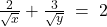 and
and 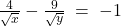 , then మరియు అయిన,
View Answer
C) x=4, y=9
Explanation:To solve the given system of equations quickly, follow this shortcut method:
Given equations:
– 1.

– 2.
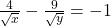
Step 1: Let’s assume new variables for simplification:
Let:
–

–

Now the equations become:
–

–

Step 2: Use substitution or elimination to solve for
and  .
.Multiply the first equation by 2 to align coefficients of
for elimination:
Now subtract the second equation from Equation 3:
![(4p + 6q) - (4p - 9q) = 4 - (-1)<span class="ql-right-eqno"> </span><span class="ql-left-eqno"> </span><img src="https://www.mcqbits.com/wp-content/ql-cache/quicklatex.com-ae6c95d609ac53910b6b37cff2b285cb_l3.png" height="17" width="167" class="ql-img-displayed-equation quicklatex-auto-format" alt="\[4p + 6q - 4p + 9q = 5\]" title="Rendered by QuickLaTeX.com"/>15q = 5<span class="ql-right-eqno"> </span><span class="ql-left-eqno"> </span><img src="https://www.mcqbits.com/wp-content/ql-cache/quicklatex.com-e924f2112135ece04c065ad0941a04e8_l3.png" height="69" width="492" class="ql-img-displayed-equation quicklatex-auto-format" alt="\[q = \frac{1}{3}$ Step 3: Substitute $ q = \frac{1}{3} $ into the first equation: $2p + 3 \times \frac{1}{3} = 2\]" title="Rendered by QuickLaTeX.com"/>2p + 1 = 2<span class="ql-right-eqno"> </span><span class="ql-left-eqno"> </span><img src="https://www.mcqbits.com/wp-content/ql-cache/quicklatex.com-7843b6c0cc98e1b3cfa8479b62e645c9_l3.png" height="16" width="49" class="ql-img-displayed-equation quicklatex-auto-format" alt="\[2p = 1\]" title="Rendered by QuickLaTeX.com"/>p = \frac{1}{2}](https://www.mcqbits.com/wp-content/ql-cache/quicklatex.com-db0ca0039eebe346296f3126b17e6e1d_l3.png "Rendered by QuickLaTeX.com")
Step 4: Solve for  and :
and :
Recall:
– and
– So  and
and 
Thus:
– 
– 
Final Answer:
– ,
50)The pair of equations x+y=5 and 2x+2y=k has infinitely many solutions if k =
x + y = 5 మరియు 2x + 2y = k అను సమీకరణాల జత అనంతమైన సాధనలను కలిగి ఉండాలి అనిన, k =
D) 10
Explanation:To determine the value of for which the system of equations has infinitely many solutions, we need to examine the two equations:
– 1.
– 2.
Step 1: Express both equations in a similar form
The second equation can be simplified by dividing both sides by 2:
Now, the system of equations becomes:
– 1.
– 2.
Step 2: Condition for infinitely many solutions
For the system to have infinitely many solutions, the two equations must represent the same line. This happens when their right-hand sides are equal. Therefore, we set:
Step 3: Solve for
Multiply both sides by 2 to solve for:
Final Answer:
The value of for which the system of equations has infinitely many solutions is 10.
x + y = 5 మరియు 2x + 2y = k అను సమీకరణాల జత అనంతమైన సాధనలను కలిగి ఉండాలి అనిన, k =
View Answer
D) 10
Explanation:To determine the value of
 for which the system of equations has infinitely many solutions, we need to examine the two equations:
– 1.

– 2.

Step 1: Express both equations in a similar form
The second equation can be simplified by dividing both sides by 2:

Now, the system of equations becomes:
– 1.
– 2.

Step 2: Condition for infinitely many solutions
For the system to have infinitely many solutions, the two equations must represent the same line. This happens when their right-hand sides are equal. Therefore, we set:

Step 3: Solve for
Multiply both sides by 2 to solve for
:
Final Answer:
The value of
for which the system of equations has infinitely many solutions is 10.Your Score: 0 / 0