
51)The roots of the quadratic equation x2-4x+4=0 are
x2 – 4x + 4 = 0 అను వర్గ సమీకరణ మూలాలు
B) 2, 2
Explanation:To find the roots of the quadratic equation , we can either factor the equation or use the quadratic formula.
Step 1: Try factoring the quadratic equation
The equation is:
We look for two numbers that multiply to give (the constant term) and add up to (the coefficient of ).
The numbers are and , since:
So, we can factor the quadratic equation as:
Step 2: Solve for the roots
Now, solving for:
Thus, the equation has a repeated root:.
Final Answer:
The roots of the quadratic equation are .
x2 – 4x + 4 = 0 అను వర్గ సమీకరణ మూలాలు
View Answer
B) 2, 2
Explanation:To find the roots of the quadratic equation
 , we can either factor the equation or use the quadratic formula.
Step 1: Try factoring the quadratic equation
The equation is:
We look for two numbers that multiply to give
 (the constant term) and add up to
  (the coefficient of
  ).
).The numbers are
 and , since:
So, we can factor the quadratic equation as:

Step 2: Solve for the roots
Now, solving for
:
Thus, the equation has a repeated root:
 .
.Final Answer:
The roots of the quadratic equation
are  .
.52)The sum of the roots of the quadratic equation 3x2 – 5x + 2 = 0 is
3x2 – 5x + 2 = 0 అనే వర్గ సమీకరణ మూలాల మొత్తము
A)
Explanation:To find the sum of the roots of the quadratic equation, we can use the formula for the sum of the roots of a quadratic equation.
The general form of a quadratic equation is:
For this equation, we have:
–
–
–
Sum of the roots:
The sum of the roots of a quadratic equation is given by the formula:
Substitute the values of and :
Final Answer:
The sum of the roots of the equation is .
The correct answer is:1..
3x2 – 5x + 2 = 0 అనే వర్గ సమీకరణ మూలాల మొత్తము
A) 
B) 
C) 
D) 
View Answer
A)
Explanation:To find the sum of the roots of the quadratic equation
 , we can use the formula for the sum of the roots of a quadratic equation.
The general form of a quadratic equation is:

For this equation, we have:
–

–

–

Sum of the roots:
The sum of the roots of a quadratic equation is given by the formula:

Substitute the values of
 and
and  :
:
Final Answer:
The sum of the roots of the equation
is  .
.The correct answer is:1.
.53)Sum of the areas of two squares is 625 m2. If the difference of their perimeters is 20 m, find the sides of the two squares.
రెండు చతురస్రాల వైశాల్యాల మొత్తము 625 చ.మీ. వాని చుట్టు కొలతల బేధము 20 మీ. అయిన, ఆ రెండు చతురస్రాల భుజాలను కనుగొనుము.
C) 20 m, 15 m
Explanation:We are given the following information:
– The sum of the areas of two squares is 625 m².
– The difference in their perimeters is 20 m.
Let the sides of the two squares be and .
Step 1: Use the sum of areas
The area of a square is given by.
So, the sum of the areas of the two squares is:
Step 2: Use the difference of perimeters
The perimeter of a square is given by.
So, the difference in the perimeters of the two squares is:
Simplifying this equation:
Step 3: Solve the system of equations
We now have the following system of equations:
– 1.
– 2.
We can solve this system by substituting (from the second equation) into the first equation.
Substitute into :
Expanding the equation:
Simplifying:
Subtract 625 from both sides:
Divide the entire equation by 2:
Now, solve this quadratic equation using the quadratic formula:
For the equation, the values of , , and are:
–
–
–
Substitute these values into the quadratic formula:
రెండు చతురస్రాల వైశాల్యాల మొత్తము 625 చ.మీ. వాని చుట్టు కొలతల బేధము 20 మీ. అయిన, ఆ రెండు చతురస్రాల భుజాలను కనుగొనుము.
View Answer
C) 20 m, 15 m
Explanation:We are given the following information:
– The sum of the areas of two squares is 625 m².
– The difference in their perimeters is 20 m.
Let the sides of the two squares be
and  .
.Step 1: Use the sum of areas
The area of a square is given by
 .
.So, the sum of the areas of the two squares is:

Step 2: Use the difference of perimeters
The perimeter of a square is given by
 .
.So, the difference in the perimeters of the two squares is:

Simplifying this equation:

Step 3: Solve the system of equations
We now have the following system of equations:
– 1.
– 2.
We can solve this system by substituting
 (from the second equation) into the first equation.
Substitute
into :
Expanding the equation:

Simplifying:

Subtract 625 from both sides:

Divide the entire equation by 2:

Now, solve this quadratic equation using the quadratic formula:
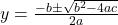
For the equation
, the values of , , and  are:
are:–

–

–

Substitute these values into the quadratic formula:
![y = \frac{-5 \pm \sqrt{5^2 - 4(1)(-300)}}{2(1)}<span class="ql-right-eqno"> </span><span class="ql-left-eqno"> </span><img src="https://www.mcqbits.com/wp-content/ql-cache/quicklatex.com-87423b63a6c2b5aeedbf4f47807e0630_l3.png" height="39" width="170" class="ql-img-displayed-equation quicklatex-auto-format" alt="\[y = \frac{-5 \pm \sqrt{25 + 1200}}{2}\]" title="Rendered by QuickLaTeX.com"/>y = \frac{-5 \pm \sqrt{1225}}{2}<span class="ql-right-eqno"> </span><span class="ql-left-eqno"> </span><img src="https://www.mcqbits.com/wp-content/ql-cache/quicklatex.com-2c7c210b3d423d315f6763edecfc1a21_l3.png" height="134" width="584" class="ql-img-displayed-equation quicklatex-auto-format" alt="\[y = \frac{-5 \pm 35}{2}$ So, we have two possible solutions for $ y $: - $ y = \frac{-5 + 35}{2} = \frac{30}{2} = 15 $ - $ y = \frac{-5 - 35}{2} = \frac{-40}{2} = -20 $ (which is not possible because side lengths cannot be negative) Therefore, $ y = 15 $. Step 4: Find $ x $ Since $ x - y = 5 $, we substitute $ y = 15 $: $x - 15 = 5\]" title="Rendered by QuickLaTeX.com"/>x = 20](https://www.mcqbits.com/wp-content/ql-cache/quicklatex.com-ff345629fcd02392d1dfb5af27c59d30_l3.png "Rendered by QuickLaTeX.com")
Final Answer:
The sides of the two squares are 20 m and 15 m.
54)How many two digit numbers are divisible by 3?
3 చే భాగించబడే రెండంకెల సంఖ్యలు ఎన్ని?
C) 30
Explanation:To find how many two-digit numbers are divisible by 3, we follow these steps:
Step 1: Find the smallest and largest two-digit numbers divisible by 3.
– The smallest two-digit number is 10, and the largest is 99.
– We need to find the smallest and largest two-digit numbers divisible by 3.
Smallest two-digit number divisible by 3:
– Divide 10 by 3:, so the next multiple of 3 is 12.
– Hence, the smallest two-digit number divisible by 3 is 12.
Largest two-digit number divisible by 3:
– Divide 99 by 3:, so 99 is divisible by 3.
– Hence, the largest two-digit number divisible by 3 is 99.
Step 2: Count the numbers divisible by 3.
The numbers divisible by 3 in the range from 12 to 99 form an arithmetic sequence where:
– First term
– Common difference
– Last term
We can use the formula for the nth term of an arithmetic sequence:
Substitute the known values:
Solve for:
3 చే భాగించబడే రెండంకెల సంఖ్యలు ఎన్ని?
View Answer
C) 30
Explanation:To find how many two-digit numbers are divisible by 3, we follow these steps:
Step 1: Find the smallest and largest two-digit numbers divisible by 3.
– The smallest two-digit number is 10, and the largest is 99.
– We need to find the smallest and largest two-digit numbers divisible by 3.
Smallest two-digit number divisible by 3:
– Divide 10 by 3:
 , so the next multiple of 3 is 12.
– Hence, the smallest two-digit number divisible by 3 is 12.
Largest two-digit number divisible by 3:
– Divide 99 by 3:
 , so 99 is divisible by 3.
– Hence, the largest two-digit number divisible by 3 is 99.
Step 2: Count the numbers divisible by 3.
The numbers divisible by 3 in the range from 12 to 99 form an arithmetic sequence where:
– First term

– Common difference

– Last term

We can use the formula for the nth term of an arithmetic sequence:

Substitute the known values:

Solve for
 :
:
*** QuickLaTeX cannot compile formula:
99 - 12 = (n - 1) \cdot 3<span class="ql-right-eqno">   </span><span class="ql-left-eqno">   </span><img src="https://www.mcqbits.com/wp-content/ql-cache/quicklatex.com-066b509ca17d428525d3a696e226a2a1_l3.png" height="19" width="118" class="ql-img-displayed-equation quicklatex-auto-format" alt="\[87 = (n - 1) \cdot 3\]" title="Rendered by QuickLaTeX.com"/>n - 1 = \frac{87}{3} = 29<pre class="ql-errors">*** QuickLaTeX cannot compile formula:
\[n = 30$
Final Answer:
There are 30 two-digit numbers divisible by 3.
So, the correct answer is:3. 30.
[/su_spoiler]
</div>
<div class="mcq-question" data-answer="A"><b>55)If P(x) = 11x<sup>8</sup> − 5x<sup>6</sup> + 4x<sup>4</sup> - 7x<sup>2</sup> +6, then the degree of P(x) is
P(x) = 11x<sup>8</sup> − 5x<sup>6</sup> + 4x<sup>4</sup> - 7x<sup>2</sup> +6, అయిన, P(x) యొక్క పరిమాణము</b>
<div class="mcq-options">
A) 8
B) 6
C) 4
D) 2
</div>
[su_spoiler title="View Answer" style="fancy" icon="arrow"]
A) 8
Explanation:The degree of a polynomial is the highest power of $ x $ in the polynomial.
Given the polynomial:
$P(x) = 11x^8 - 5x^6 + 4x^4 - 7x^2 + 6$
Let's look at the powers of $ x $:
- The highest power of $ x $ is $ x^8 $ (from the term $ 11x^8 $).
Therefore, the degree of $ P(x) $ is 8.
Final Answer:
The degree of $ P(x) $ is 8.
So, the correct answer is:1. 8.
[/su_spoiler]
</div>
<div class="mcq-question" data-answer="D"><b>56)A chord of a circle of radius 4 cm is making an angle 60° at the centre, then the length of the chord is
4 సెం.మీ. వ్యాసార్ధం కలిగిన వృత్తంలో ఒక జ్యా కేంద్రం వద్ద 60° కోణం చేస్తుంది. అప్పుడు, ఆ జ్యా పొడవు</b>
<div class="mcq-options">
A) 1 cm
B) 2 cm
C) 3 cm
D) 4 cm
</div>
[su_spoiler title="View Answer" style="fancy" icon="arrow"]
D) 4 cm
Explanation:To find the length of the chord of a circle given the radius and the angle at the center, we can use the following formula:
$\text{Length of the chord} = 2r \sin\left(\frac{\theta}{2}\right)$
Where:
- $ r $ is the radius of the circle.
- $ \theta $ is the angle at the center in degrees.
Given:
- Radius $ r = 4 $ cm
- Angle $ \theta = 60^\circ $
Now, using the formula:
$\text{Length of the chord} = 2 \times 4 \times \sin\left(\frac{60^\circ}{2}\right)\]
*** Error message:
Display math should end with $$.
leading text: \[n = 30$
Missing $ inserted.
leading text: [/su_
Unicode character − (U+2212)
leading text: ...er="A"><b>55)If P(x) = 11x<sup>8</sup> −
Unicode character − (U+2212)
leading text: P(x) = 11x<sup>8</sup> −
Unicode character అ (U+0C05)
leading text: ... + 4x<sup>4</sup> - 7x<sup>2</sup> +6, అ
Unicode character య (U+0C2F)
leading text: ...4x<sup>4</sup> - 7x<sup>2</sup> +6, అయ
Unicode character ి (U+0C3F)
leading text: ...sup>4</sup> - 7x<sup>2</sup> +6, అయి
Unicode character న (U+0C28)
leading text: ...>4</sup> - 7x<sup>2</sup> +6, అయిన
Unicode character య (U+0C2F)
leading text: ... 7x<sup>2</sup> +6, అయిన, P(x) య
Unicode character ొ (U+0C4A)
leading text: ...<sup>2</sup> +6, అయిన, P(x) యొ
</pre>\text{Length of the chord} = 8 \times \sin(30^\circ)

*** Error message:
Missing $ inserted.
leading text: 99 - 12 = (n - 1) \cdot
Bad math environment delimiter.
leading text: ...ed-equation quicklatex-auto-format" alt="\[
Missing \endgroup inserted.
leading text: ...-auto-format" alt="\[87 = (n - 1) \cdot 3\]
\begin{document} ended by \end{equation*}.
leading text: ...-auto-format" alt="\[87 = (n - 1) \cdot 3\]
Missing $ inserted.
leading text: ...-auto-format" alt="\[87 = (n - 1) \cdot 3\]
Extra \endgroup.
leading text: ...-auto-format" alt="\[87 = (n - 1) \cdot 3\]
Missing $ inserted.
leading text: ...ed by QuickLaTeX.com"/>n - 1 = \frac{87}{3}
Extra }, or forgotten $.
leading text: ...ed by QuickLaTeX.com"/>n - 1 = \frac{87}{3}
Bad math environment delimiter.
leading text: \[
Missing \endgroup inserted.
leading text: \[n = 30$
Since  :
:

Final Answer:
The length of the chord is 4 cm.
So, the correct answer is:4. 4 cm.
57)The discriminant of the quadratic equation
అను వర్గ సమీకరణము యొక్క విచక్షణి
C) 0
Explanation:To find the discriminant () of a quadratic equation, we use the formula:
For the quadratic equation, the coefficients are:
–
–
–
Step 1: Calculate the discriminant
Substitute the values of, , and into the discriminant formula:
Step 2: Simplify the expression
 అను వర్గ సమీకరణము యొక్క విచక్షణి
View Answer
C) 0
Explanation:To find the discriminant (
 ) of a quadratic equation, we use the formula:
For the quadratic equation
, the coefficients are:–
–

–

Step 1: Calculate the discriminant
Substitute the values of
, , and into the discriminant formula:
Step 2: Simplify the expression
![\Delta = 4 - 4 \times 1<span class="ql-right-eqno"> </span><span class="ql-left-eqno"> </span><img src="https://www.mcqbits.com/wp-content/ql-cache/quicklatex.com-f95d00e7a3d02bd2254894be50d79ebc_l3.png" height="314" width="590" class="ql-img-displayed-equation quicklatex-auto-format" alt="\[\Delta = 4 - 4 = 0$ Final Answer: The discriminant is 0. So, the correct answer is:3. 0. [/su_spoiler] </div> <div class="mcq-question" data-answer="C"><b>58)If −1, −2 are two zeros of a polynomial $2x^3\;+\;ax^2\;+\;bx\;-\;2 $, then the values of a and b are $2x^3\;+\;ax^2\;+\;bx\;-\;2 $ అను బహుపది యొక్క రెండు శూన్యాలు -1, -2 అయిన, a మరియు b యొక్క విలువలు</b> <div class="mcq-options"> A) 2, -1 B) -5, -1 C) 5, 1 D) -2, -1 </div> [su_spoiler title="View Answer" style="fancy" icon="arrow"] C) 5, 1 Explanation:We are given the polynomial equation $2x^3 + ax^2 + bx - 2$, and the two zeros of the polynomial are $x = -1$ and $x = -2$. Step 1: Use the fact that the polynomial is zero at these points We can substitute $x = -1$ and $x = -2$ into the polynomial equation. Since these values are roots of the polynomial, the equation should equal zero at these points. For x = -1: Substitute $x = -1$ into the equation $2x^3 + ax^2 + bx - 2 = 0$: $2(-1)^3 + a(-1)^2 + b(-1) - 2 = 0\]" title="Rendered by QuickLaTeX.com"/>2(-1) + a(1) + b(-1) - 2 = 0<span class="ql-right-eqno"> </span><span class="ql-left-eqno"> </span><img src="https://www.mcqbits.com/wp-content/ql-cache/quicklatex.com-fb117d862620e45b0d6167a0d4efb60f_l3.png" height="14" width="145" class="ql-img-displayed-equation quicklatex-auto-format" alt="\[-2 + a - b - 2 = 0\]" title="Rendered by QuickLaTeX.com"/>a - b - 4 = 0<span class="ql-right-eqno"> </span><span class="ql-left-eqno"> </span><img src="https://www.mcqbits.com/wp-content/ql-cache/quicklatex.com-c907bc8ad72b2ccf05ce72757f8e70ab_l3.png" height="73" width="582" class="ql-img-displayed-equation quicklatex-auto-format" alt="\[a - b = 4 \quad \text{(Equation 1)}$ For $x = -2$: Substitute $x = -2$ into the equation $2x^3 + ax^2 + bx - 2 = 0$: $2(-2)^3 + a(-2)^2 + b(-2) - 2 = 0\]" title="Rendered by QuickLaTeX.com"/>2(-8) + a(4) + b(-2) - 2 = 0<span class="ql-right-eqno"> </span><span class="ql-left-eqno"> </span><img src="https://www.mcqbits.com/wp-content/ql-cache/quicklatex.com-3d4485a95d5a730657f82f1cb906f6c4_l3.png" height="14" width="171" class="ql-img-displayed-equation quicklatex-auto-format" alt="\[-16 + 4a - 2b - 2 = 0\]" title="Rendered by QuickLaTeX.com"/>4a - 2b - 18 = 0](https://www.mcqbits.com/wp-content/ql-cache/quicklatex.com-7bde67d6bc1383178d6be9a320d12560_l3.png "Rendered by QuickLaTeX.com")

Step 2: Solve the system of equations
We now have the system of equations:
– 1. a – b = 4
– 2. 2a – b = 9
Subtract Equation 1 from Equation 2:
(2a – b) – (a – b) = 9 – 4
2a – b – a + b = 5
a = 5
Substitute a = 5 into Equation 1:
5 – b = 4
b = 1
Final Answer:
The values of a and b are:a = 5, b = 1
So, the correct answer is 3. 5, 1.
59)If α, β are the zeros of the polynomial P(x) = 3x2 – x – 4, then α . β =
P(x) = 3x2 – x – 4 అను బహుపది యొక్క శూన్యాలు α, β అయిన, α . β =
A)
Explanation:We are given the quadratic polynomial and are asked to find the product of its zeros, .
Step 1: Use the relationship between the coefficients and the zeros
For a quadratic equation of the form, the sum and product of the roots (zeros) are given by:
– Sum of the roots:
– Product of the roots:
Here, the quadratic equation is, so:
– a = 3
– b = -1
– c = -4
Step 2: Find the product of the roots
The product of the roots is given by:
Final Answer:
The value of is .
So, the correct answer is 1..
P(x) = 3x2 – x – 4 అను బహుపది యొక్క శూన్యాలు α, β అయిన, α . β =
A) 
B) 
C) 
D) 
View Answer
A)
Explanation:We are given the quadratic polynomial
 and are asked to find the product of its zeros,
  .
.Step 1: Use the relationship between the coefficients and the zeros
For a quadratic equation of the form
, the sum and product of the roots (zeros) are given by:– Sum of the roots:

– Product of the roots:

Here, the quadratic equation is
 , so:
, so:– a = 3
– b = -1
– c = -4
Step 2: Find the product of the roots
The product of the roots
is given by:
Final Answer:
The value of
is  .
.So, the correct answer is 1.
.60)Which term of the A.P.: 20, 18, 16, is ‘-80’?
20, 18, 16, …. అనే అంకశ్రేఢిలో ‘-80’ ఎన్నవ పదము?
B) 51
Explanation:We are given the arithmetic progression (A.P.): 20, 18, 16, … and are asked to find which term of this A.P. is equal to -80.
Step 1: Write the general formula for the nth term of an A.P.
The nth term of an arithmetic progression is given by:
where:
– is the nth term,
– a is the first term,
– d is the common difference,
– n is the position of the term.
Step 2: Find the common difference d
The common difference d is the difference between consecutive terms:
d = 18 – 20 = -2
Step 3: Substitute values into the formula
We need to find n when. Using the formula:
Substitute a = 20, d = -2, and:
Step 4: Solve for n
Simplify the equation:
-80 = 20 – 2(n – 1)
-80 – 20 = -2(n – 1)
-100 = -2(n – 1)
Now, divide both sides by -2:
50 = n – 1
Add 1 to both sides:
n = 51
Final Answer:
The term of the A.P. that is -80 is the 51st term.
20, 18, 16, …. అనే అంకశ్రేఢిలో ‘-80’ ఎన్నవ పదము?
View Answer
B) 51
Explanation:We are given the arithmetic progression (A.P.): 20, 18, 16, … and are asked to find which term of this A.P. is equal to -80.
Step 1: Write the general formula for the nth term of an A.P.
The nth term of an arithmetic progression is given by:

where:
–
 is the nth term,
– a is the first term,
– d is the common difference,
– n is the position of the term.
Step 2: Find the common difference d
The common difference d is the difference between consecutive terms:
d = 18 – 20 = -2
Step 3: Substitute values into the formula
We need to find n when
 . Using the formula:
Substitute a = 20, d = -2, and
:
Step 4: Solve for n
Simplify the equation:
-80 = 20 – 2(n – 1)
-80 – 20 = -2(n – 1)
-100 = -2(n – 1)
Now, divide both sides by -2:
50 = n – 1
Add 1 to both sides:
n = 51
Final Answer:
The term of the A.P. that is -80 is the 51st term.
Your Score: 0 / 0