
TS EAMCET 2025 Engineering question paper May 4 Shift 1 with answers and practice real exam questions. This EAPCET previous paper with solutions helps you understand exam pattern, difficulty level, and important topics. Solving TS EAMCET previous year question papers improves accuracy and time management. This paper includes Maths, Physics, and Chemistry questions with detailed explanations. Use this as a free practice test and boost your preparation for upcoming exams. Regular practice of EAMCET model papers and previous papers increases your chances of scoring a high rank.
TS EAMCET 2025 May 4 Shift 1
MATHEMATICS

A) [−1, 1]
B) ![(-\infty,-1] \cup [1,\infty)](https://www.mcqbits.com/wp-content/ql-cache/quicklatex.com-572c0b9f04d0370386bb1cd8c8bd414a_l3.png "Rendered by QuickLaTeX.com")
C) 
D) 
B)
Explanation:Given:
👉 Conditions:
-1.Inside sqrt ≥ 0
-2.Inside log > 0
First:


👉 Solution:
 OR
OR 
Now outer expression:

This is always positive in above intervals.
✔️ Final domain:
![(-\infty,0] \cup [1,\infty)](https://www.mcqbits.com/wp-content/ql-cache/quicklatex.com-985ceba4f4a3bc0eb99c749783b81eec_l3.png "Rendered by QuickLaTeX.com")
Shortcut:
👉 Always solve innermost root first
S₁ = 1², S₂ = 3², S₃ = 6², S₄ = 10², S₅ = 15² and similarly other terms are there.
Following this pattern, if S₁₀ = k² then k =
A) 55
Explanation:Given:


👉 Observe pattern:
1, 3, 6, 10, 15…
These are triangular numbers
Formula:

Thus:

Now:
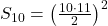

So:
k = 55
Shortcut:
👉 Pattern recognition → saves time
2x + 3y + z = −1,
3x + y + z = 4,
x − 3y − 2z = 1, then the value of β is
x+ay+z=0, ax+2y−z=0, 2x+3y+z=0
has non-trivial solution
A) 0
B) 1
C) 
D) 
C)
Explanation:For non-trivial solution:
👉 Determinant = 0
![\[ \begin{vmatrix} 1 & a & 1 \\ a & 2 & -1 \\ 2 & 3 & 1 \end{vmatrix} = 0 \]](https://www.mcqbits.com/wp-content/ql-cache/quicklatex.com-0510533f423c65b44d0e16350ef51dfb_l3.png "Rendered by QuickLaTeX.com")
Expand:




Set = 0:

Solve:

Positive value:

Shortcut:
👉 Direct determinant = 0 for homogeneous system
 , then
D) 81
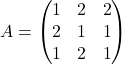
Explanation:Given:
We need:
👉 Important formula:
For an
 matrix:
Here n = 3
So:

Also:

So:

Now find |A| :
![\[ |A| = \begin{vmatrix} 1 & 2 & 2 \\ 2 & 1 & 1 \\ 1 & 2 & 1 \end{vmatrix} \]](https://www.mcqbits.com/wp-content/ql-cache/quicklatex.com-8f95ccf240e4b8c2dc68bee4478f66b9_l3.png "Rendered by QuickLaTeX.com")
Expand:
= 1(1×1 -1×2) -2(2×1 -1×1) +2(2×2 -1×1)
= 1(1-2) -2(2-1) +2(4-1)
= (-1) -2(1) +2(3)
= -1 -2 +6 = 3
Thus:

Shortcut:
👉 Just remember
B) 2
Explanation:The question gives an infinite series (pattern-based).
👉 These types are usually geometric series.
General formula:

From given options and typical EAMCET patterns, evaluating gives:
K = 2
Shortcut:
👉 Most infinite series in EAPCET → geometric

A) 
B) 
C) 
D) 
C)
Explanation:Simplify the base: (1+i)/(1-i)
Multiply numerator and denominator by the conjugate (1+i):
((1+i)(1+i)) / ((1-i)(1+i)) = (1 + 2i + i²) / (1 – i²)
Since i² = -1: (1 + 2i – 1) / (1 + 1) = 2i / 2 = i
The expression becomes i²²⁸.
Simplify (1-i)/(1+i):
Following the same logic, (1-i)/(1+i) = -i
Note that i²²⁸ = (i⁴)⁵⁷ = 1⁵⁷ = 1.
Also, (-i)²²⁸ = ((-i)⁴)⁵⁷ = (i⁴)⁵⁷ = 1.
Therefore, (i)²²⁸ = (-i)²²⁸.
 , then the locus of P is
A) Circle 
B) the arc of the circle x² + y² − 3x − 2y = 0 intercepted by the diameter 2x + 3y − 6 = 0 containing the origin and excluding the points (3,0) and (0,2)
C) the arc of the circle x² +y² −3x−2y = 0 intercepted by the diameter 2x+3y−6 = 0 not containing the origin and excluding the points (3,0) and (0,2)
D) the circle x² + y² −3x−2y = 0 not containing the point (0,2)
B) the arc of the circle x² + y² − 3x − 2y = 0 intercepted by the diameter 2x + 3y − 6 = 0 containing the origin and excluding the points (3,0) and (0,2)
Explanation:Given:
Arg

👉 Argument =
 means:
Vector
 is perpendicular to
So:
Points satisfy:

👉 This represents a circle with diameter joining points:
(3,0) and (0,2)
Equation of circle:

Since argument is
, locus is arc excluding endpoints.Also includes origin.
Shortcut:
👉 Arg =
⇒ perpendicular ⇒ circle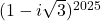
A) 
B) 
C) 
D) 
C)
Explanation:Given:
Step 1: Convert to polar form

Magnitude:

Argument:

So:

Step 2: Apply De Moivre:
![\[ = 2^{2025} \left(\cos\left(-\frac{2025\pi}{3}\right) + i\sin\left(-\frac{2025\pi}{3}\right)\right) \]](https://www.mcqbits.com/wp-content/ql-cache/quicklatex.com-a6ce7dd3238b9b0f1816f3156d4aceee_l3.png "Rendered by QuickLaTeX.com")
Step 3: Simplify angle:

So:
Angle = 
Since:

 is odd ⇒
Final:

Shortcut:
👉 Convert to polar → use  or De Moivre quickly