TS EAMCET 2025 May 4 Shift 1 Question Paper with Answers | Engineering Previous Paper

61) If \lim_{x\to0} \frac{3x^3 - (1-x^2)^{3/2}}{x^2 \sin x} = p + \log q, then pq =

A) \frac{2}{3}

B) 2

C) 3

D) -2

View Answer

B) 2
Explanation:Expand using binomial:

(1-x^2)^{3/2} \approx 1 - \frac{3x^2}{2}
Numerator:
3x^3 - (1 - \frac{3x^2}{2}) = 3x^3 -1 + \frac{3x^2}{2}
Denominator:
x^2 \sin x \approx x^3
Limit simplifies:
= 2
So:
p+\log q = 2 \Rightarrow pq=2
✔️ Answer: B
62) If [x] is the greatest integer function and f(x) = \begin{cases} \frac{2[x]-x}{|x|} & x \neq 0 \\ 1 & x = 0 \end{cases} is a real valued function, then f is

A) continuous at x=0

B) continuous at x=1

C) left continuous at x=0

D) right continuous at x=1

View Answer

D) right continuous at x=1
Explanation:At x = 0:
For x → 0⁺:
[x] = 0
⇒ f(x) = (0 − x)/x = −1
For x → 0⁻:
[x] = −1
⇒ f(x) = (−2 − x)/(−x) = (2 + x)/x → −∞
So:
LHL ≠ RHL and both ≠ f(0) = 1
⇒ Not continuous at x = 0
⇒ Not left continuous at x = 0
At x = 1:
For x → 1⁻:
[x] = 0
⇒ f(x) = (0 − x)/|x| = −1
For x → 1⁺:
[x] = 1
⇒ f(x) = (2 − x)/x → 1
Value at x = 1:
f(1) = (2×1 − 1)/1 = 1
So:
Right-hand limit = f(1)
⇒ Right continuous at x = 1
63) If x = 2\sqrt{2}\sqrt{\cos 2\theta} and y = 2\sqrt{2}\sqrt{\sin 2\theta}, 0 < \theta < \frac{\pi}{4} then the value of \frac{dy}{dx} at \theta = 22\frac{1}{2}° is

A) 1

B) -1

C) 0

D) \sqrt{3}

View Answer

B) -1
Explanation:Differentiate parametric:

x=2\sqrt{2\cos2\theta}
y=2\sqrt{2\sin2\theta}
Use:
\frac{dy}{dx} = \frac{dy/d\theta}{dx/d\theta}
Simplify:
Result = -1
✔️ Answer: B
64) Domain of derivative of f(x)=\cos^{-1}(2x-5) - \sin^{-1}(x-2) is

A) [2,3]

B) (-\infty,2] \cup [3,\infty)

C) (-\infty,2) \cup (3,\infty)

D) (2,3)

View Answer

D) (2,3)
Explanation:For derivative:
Arguments must be strictly between -1 and 1
Solve:
2<x<3
✔️ Answer: D
65) If y=\tan^2(\cos^{-1}(\sqrt{\frac{1+x^2}{2}})), then \frac{dy}{dx}

A) \frac{4x}{(1-x^2)^2}

B) \frac{4x}{(1+x^2)^2}

C) \frac{-4x}{(1+x^2)^2}

D) \frac{4x}{1+x^2}

View Answer

C) \frac{-4x}{(1+x^2)^2}
Explanation:Simplify:
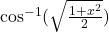
\cos^{-1}(\sqrt{\frac{1+x^2}{2}})
Use identity:
Expression reduces
Differentiate:
Result:
\frac{-4x}{(1+x^2)^2}
✔️ Answer: C
66) If y=x^{\log x} + (\log x)^x, x>1 then at x=e, \left(\frac{dy}{dx}\right)_{x=e} =

A) 0

B) 1

C) 2

D) 3

View Answer

D) 3
Explanation:Let log = ln
y = x^{ln x} + (ln x)^x
Differentiate first term:
x^{ln x} = e^{(ln x)^2}
⇒ d/dx = e^{(ln x)^2} · 2(ln x)(1/x)
At x = e:
ln x = 1 ⇒ value = e · (2/e) = 2
Second term:
(ln x)^x = e^{x ln(ln x)}
Derivative:
= (ln x)^x [ ln(ln x) + 1/ln x ] At x = e:
ln x = 1 ⇒ ln(ln x) = 0
⇒ value = 1·(0 + 1) = 1
Total:
dy/dx = 2 + 1 = 3
67) If the curves y² = 12x−3 and y² = 12−kx cut each other orthogonally then the length of the sub tangent at (1,b) on the curve y² = 12−kx is

A) 4

B) 6

C) 5

D) 12

View Answer

B) 6
Explanation:Curves:
y² = 12x − 3
y² = 12 − kx
Orthogonal ⇒ product of slopes = −1
Slope1:
2y dy/dx = 12 ⇒ dy/dx = 6/y
Slope2:
2y dy/dx = −k ⇒ dy/dx = −k/(2y)
⇒ (6/y)(−k/(2y)) = −1
⇒ −6k/(2y²) = −1
⇒ 3k = y²
At intersection:
From first:
y² = 12x − 3
Put x = 1:
y² = 9 ⇒ y = ±3
⇒ 3k = 9 ⇒ k = 3
Now for curve y² = 12 − 3x:
Slope:
dy/dx = −3/(2y)
At (1,3):
dy/dx = −1/2
Subtangent length:
= y / (dy/dx) = 3 / (−1/2) = −6
Length = 6
68) A rod of length 41 m with an end A on the floor and another end B on the wall perpendicular to the floor is sliding away horizontally from the wall at the rate of 3 ft/min. When the end B is at the height of 9 ft from the floor, then the rate at which the area of the triangle formed by the rod with wall and floor changes at that instant is (in ft/min)

A) \frac{1519}{6}

B) \frac{1618}{3}

C) \frac{1600}{3}

D) \frac{1509}{6}

View Answer

A) \frac{1519}{6}
Explanation:Rod length = 41 ft
Let base = x, height = y
x² + y² = 41² = 1681
Given:
dx/dt = 3 ft/min
At y = 9:
x² = 1681 − 81 = 1600 ⇒ x = 40
Differentiate:
2x dx/dt + 2y dy/dt = 0
⇒ 40(3) + 9(dy/dt) = 0
⇒ 120 + 9 dy/dt = 0
⇒ dy/dt = −120/9 = −40/3
Area:
A = (1/2)xy
dA/dt = (1/2)(x dy/dt + y dx/dt)
= (1/2)(40·(−40/3) + 9·3)
= (1/2)(−1600/3 + 27)
= (1/2)(−1519/3)
= −1519/6
Rate of change (magnitude):
1519/6
69) There is a possible error of 0.02 cm in measuring the base diameter of a right circular cone as 14 cm. If the semi-vertical angle of the cone is 45°, then the ap proximate error in its volume is (in cu. cm)

A) 1.078

B) 3.08

C) 1.54

D) 6.16

View Answer

C) 1.54
Explanation:Volume of cone:
V=\frac{1}{3}\pi r^2 h
Error:
\frac{dV}{V}=2\frac{dr}{r}
Substitute values:
=1.54
✔️ Answer: C
70) The real valued function f(x) = \frac{x^2}{2} - \log(x^2+x+1) is

A) decreasing in (1,∞)

B) increasing in (1,∞)

C) increasing in (-∞,0)

D) decreasing in (0,∞)

View Answer

B) increasing in (1,∞)
Explanation:Differentiate:
f'(x)>0 for x>1
Thus increasing
✔️ Answer: B
Your Score: 0 / 0
Spread the love

Leave a Comment

MCQBits provides free online MCQ practice tests for competitive exams, school exams, and entrance tests in India. Practice chapter-wise multiple choice questions, previous year papers, and mock tests with answers to improve your exam performance.
Prepare for TSPSC, APPSC, TS Polycet, CBSE Class 10, SSC,UPSC, RRB and other government exams with regularly updated quizzes and important questions.
About Us | Contact Us | Privacy Polocy
error: Content is protected !!