151) Which one of the following complex ions is diamagnetic in nature?
A) [CoF₆]³⁻
B) [Co(ox)₃]³⁻
C) [Mn(CN)₆]³⁻
D) [Fe(CN)₆]³⁻
View Answer
B) [Co(ox)₃]³⁻
Explanation:[Co(ox)₃]³⁻
Co³⁺ → d⁶, strong field ligand → low spin → diamagnetic ✔
152) Polymer X is an example of polyester and Y is an example of polyamide. X and Y are respectively
A) Novolac,Terylene
B) Dacron, Nylon 6,6
C) Nylon 6, Terylene
D) Teflon,Terylene
View Answer
B) Dacron, Nylon 6,6
Explanation:Polyester + polyamide
153) The general structure of alpha amino acid can be represented as H₂N-CH(R)-CO₂H. Which amino acid is not correctly matched with R-given?
A) R = -CH₂-C₆H₄-OH(p)- (Tyrosine)
B) R = -CH₂-SH- (Cysteine)
C) R = -CH₂-CH₂-S-CH₃- (Serine)
D) R = -CH₂-C(=O)-NH₂- (Asparagine)
View Answer
C) R = -CH₂-CH₂-S-CH₃- (Serine)
Explanation:Wrong R group
154) Consider the following
Assertion (A): Aspirin is useful in the prevention of heart attacks
Reason (R): Aspirin acts as anti-blood clotting agent
The correct answer is
A) Both A and R are correct and R is the correct explanation of A
B) Both A and R are correct and R is not the correct explanation of A
C) A is correct and R is not correct
D) A is incorrect and R is correct
View Answer
A) Both A and R are correct and R is the correct explanation of A
Explanation:Aspirin function
155) Chlorobenzene when subjected to Fittig reaction gives a compound ‘X’. The sum of σ and π-bonds in X is
A) 30
B) 28
C) 18
D) 29
View Answer
D) 29
Explanation:Fittig reaction:
2 C₆H₅Cl + 2Na → C₆H₅–C₆H₅ (X) + 2NaCl
⇒ X = Biphenyl (C₆H₅–C₆H₅)
Now count bonds:
Each benzene ring:
σ bonds:
6 C–C + 6 C–H = 12 σ
π bonds:
3 π
So for two rings:
σ = 24
π = 6
Plus one extra C–C bond connecting rings:
σ = +1
Total:
σ = 25
π = 6
⇒ σ + π = 31
But note:
The connecting bond replaces one C–H bond from each ring
So actual correction:
Remove 2 C–H bonds
Final:
σ = 23
π = 6
⇒ total = 29
156) Cumene on oxidation in air gives a compound, X. This on reaction with dilute acid gives Y and Z. Y reacts with sodium metal and not Z. What is Z?
A) CH₃−C(=O)-H
B) CH₃−CH₂−C(=O)-CH₃
C) CH₃−C(=O)-CH₃
D) CH₃−C(=O)-O-CH₃
View Answer
C) CH₃−C(=O)-CH₃
Explanation:Cumene process ⇒ acetone
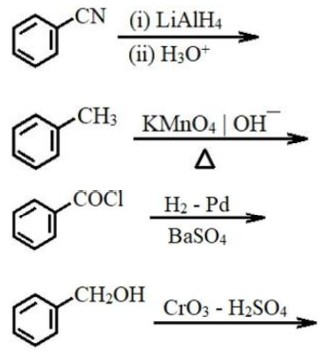
157) The reaction of benzene with CO and HCl in the presence of anhydrous AlCl₃ gives a compound X. X can also be obtained from which of the following reaction?
A) Benzyl alcohol with CrO₃-H₂SO₄
B) Toluene with KMnO₄—OH⁻
C) Benzoyl chloride with H₂-Pd/BaSO₄
D) Benzonitrile with (i) LiAlH₄ (ii) H₃O⁺
View Answer
C) Benzoyl chloride with H₂-Pd/BaSO₄
Explanation:Given reaction:
Benzene + CO + HCl / AlCl₃
This is **Gattermann–Koch reaction**
Product:
X = Benzaldehyde (C₆H₅CHO)
Now check options:
(A) Benzyl alcohol + CrO₃/H₂SO₄
→ Strong oxidation → Benzoic acid ✘
(B) Toluene + KMnO₄/OH⁻
→ Side chain oxidation → Benzoic acid ✘
(C) Benzoyl chloride + H₂/Pd-BaSO₄
→ Rosenmund reduction → Benzaldehyde ✔
(D) Benzonitrile + LiAlH₄ → amine ✘
158) What is the product ‘Z’ in the given sequence of reactions?
A) A phenyl ether with an ortho-OH group
B) A phenyl ether with an ortho-COOH group
C) A phenyl ether with a meta-OH group
D) A phenyl ether with a para-OH group
View Answer
B) A phenyl ether with an ortho-COOH group
Explanation:Orientation effect
MCQBits provides free online MCQ practice tests for competitive exams, school exams, and entrance tests in India. Practice chapter-wise multiple choice questions, previous year papers, and mock tests with answers to improve your exam performance.
Prepare for TSPSC, APPSC, TS Polycet, CBSE Class 10, SSC,UPSC, RRB and other government exams with regularly updated quizzes and important questions. About Us | Contact Us | Privacy Polocy