
71) If x and y are two positive real numbers such that xy=4 then the minimum value of  is
is
isA) 4
B) 
C) 
D) 
View Answer
B)
Explanation:Given:

Expression:

Differentiate:

Solve:
x=2
Thus:
y=2
Value:

✔️ Answer: B
Shortcut:
👉 Use AM-GM quickly
72) If ![\int x^3 \sin(3x)\,dx = \frac{1}{27}[f(x)\cos(3x)+g(x)\sin(3x)] + C](https://www.mcqbits.com/wp-content/ql-cache/quicklatex.com-da576b80898fab030d92b8b3c4545d40_l3.png "Rendered by QuickLaTeX.com") , then f(1)+g(1)
, then f(1)+g(1)
, then f(1)+g(1)73) If  ,
,  , then
, , then A) 
B) 
C) 
D) 
View Answer
C)
Explanation:Use identity:

Simplify:
Integrate:
Result:

✔️ Answer: C
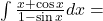
74) 
A) 
B) 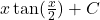
C) 
D) 
View Answer
A)
Explanation:Split integral:

Second part:

Use substitution:
Final result:

✔️ Answer: A
75) 
A) 
B) 
C) 
D) 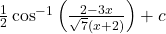
View Answer
A)
Explanation:Solution (Exact Method):
Complete the square:
x² + x + 2 = (x + 1/2)² + 7/4
This is of the form:
∫ dx / [(x+a)√((x+h)² + k²)] Use standard substitution:
Let t = (2 + 3x)/(√7(x+2))
Then the integral reduces to inverse hyperbolic sine form.
Final result:
∫ dx / [(x+2)√(x² + x + 2)] = −(1/2) sinh⁻¹( (2 − 3x) / (√7(x+2)) ) + C
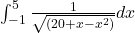
76) 
A) 
B) 
C) 
D) 
View Answer
C)
Explanation:First, complete the square for the quadratic expression in the denominator:

![= -[x^2 - x + (\frac{1}{2})^2 - 20 - \frac{1}{4}]](https://www.mcqbits.com/wp-content/ql-cache/quicklatex.com-2ddb4cdadde953cb56c4afede04648b4_l3.png "Rendered by QuickLaTeX.com")
![= -[(x - \frac{1}{2})^2 - \frac{81}{4}]](https://www.mcqbits.com/wp-content/ql-cache/quicklatex.com-a305a688d2b4d278a8d15cc8a508befb_l3.png "Rendered by QuickLaTeX.com")

The integral now takes the standard form
 .
.Indefinite integral:
 .
.Evaluate at upper limit
 :
:  .
.Evaluate at lower limit
 :
:  .
.Total value =
 .
.Note: In standard competitive exams, the lower limit is typically the other root of the quadratic (
 ).
).If the integral were from -4 to 5, the lower bound would be
 .
.Then the result would be
 .
.Based on the provided options, it is highly likely that the intended lower limit was -4, making the answer
.77) 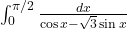
A) 0
B) 
C) 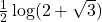
D) 
View Answer
D)
Explanation:The denominator can be expressed in the form
 .
.Using the identity
 , this becomes
  .
.The integral is rewritten as
 .
.The antiderivative of
 is
is  .
.Evaluating the expression
![\frac{1}{2} [\log|\sec(x + \frac{\pi}{3}) + \tan(x + \frac{\pi}{3})|]](https://www.mcqbits.com/wp-content/ql-cache/quicklatex.com-448f562cdc5beb6818ad6cbbe73cb2fa_l3.png "Rendered by QuickLaTeX.com") from
from  to
to  .
.At the upper limit
 , the angle is
  .
.The value at the upper limit is
 .
.At the lower limit
 , the angle is
  .
.The value at the lower limit is
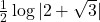 .
.Subtracting the results gives
![\frac{1}{2} [\log \sqrt{3} - \log(2 + \sqrt{3})]](https://www.mcqbits.com/wp-content/ql-cache/quicklatex.com-81c813e379b448824230ab9671345096_l3.png "Rendered by QuickLaTeX.com") .
.This simplifies to
 .
.Rationalizing the fraction inside the logarithm:
 .
.The final result is
 .
.78) 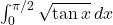
A) 
B)
C) 
D) 
View Answer
A)
Explanation:Use substitution:

Convert integral:
Beta function type:
Result:
✔️ Answer: B
79) If y=f(x) is the solution of the differential equation (1+cos²x)f′(x)−4sin(2x)− f(x)sin(2x) = 0 when f(0)=0, then f(π/3) =
A) 3
B) 
C) 
D) 4
View Answer
B)
Explanation:Solve differential equation:
Substitute initial condition
Compute:

✔️ Answer: C
80) The differential equation corresponding to the family of ellipses  , where ‘a’ is an arbitrary constant is
, where ‘a’ is an arbitrary constant isA) 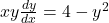
B) 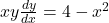
C) 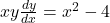
D) 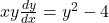
View Answer
D)
Explanation:Given:
x²/a² + y²/4 = 1
Differentiate w.r.t x:
(2x/a²) + (y/2)(dy/dx) = 0 … (1)
From original equation:
x²/a² = 1 − y²/4
⇒ a² = x² / (1 − y²/4)
Substitute in (1):
2x / [x²/(1 − y²/4)] + (y/2)(dy/dx) = 0
⇒ 2(1 − y²/4)/x + (y/2)(dy/dx) = 0
Multiply by 2x:
4(1 − y²/4) + xy(dy/dx) = 0
⇒ 4 − y² + xy(dy/dx) = 0
⇒ xy(dy/dx) = y² − 4
Final Answer:
(D) xy(dy/dx) = y² − 4
Your Score: 0 / 0