TS EAMCET 2025 May 4 Shift 1 Question Paper with Answers | Engineering Previous Paper

41) If A=(0, 1), B=(1, 2), C=(-2, 1) then the equation of the locus of a point P such that area of triangle PAB = area of triangle PAC is

A) x^2 -2xy -3y^2 +2x +6y -3 =0

B) x^2 +2xy -3y^2 +2x +6y -4 =0

C) x^2 -2xy -3y^2 +2x -6y +4 =0

D) x^2 -2xy +3y^2 -2x +6y -3 =0

View Answer

A) x^2 -2xy -3y^2 +2x +6y -3 =0
Explanation:Condition:
Area(PAB) = Area(PAC)
Use determinant formula for area:
Set equal:
Simplifies to quadratic equation:
x^2 -2xy -3y^2 +2x +6y -3 =0
✔️ Answer: A
Shortcut:
👉 Equal area ⇒ determinant equality
42) (a, b) are the new coordinates of the point (2, 3) after shifting the origin to the point (3, 2) by translation of axes. If (c, d) are the new coordinates of the point (a, b) after rotating the axes through an angle \frac{\pi}{4} about the origin in the anti-clockwise direction, then d-c =

A) 0

B) 1

C) \sqrt{2}

D) 2\sqrt{2}

View Answer

C) \sqrt{2}
Explanation:Step 1: Translation:
New coordinates:
a = 2-3 = -1
b = 3-2 = 1
Step 2: Rotation by \frac{\pi}{4}
Using rotation formulas:
x' = \frac{x-y}{\sqrt{2}}, y' = \frac{x+y}{\sqrt{2}}
Compute:
Result ⇒ d-c = \sqrt{2}
✔️ Answer: C
43) The lines x+y+4=0, x-2y-4=0 and 3x+4y-2=0

A) concurrent

B) isosceles triangle

C) right-angled triangle

D) scalene triangle

View Answer

D) scalene triangle
Explanation:Find slopes:
Line 1: x + y + 4 = 0 ⇒ y = −x − 4 ⇒ m₁ = −1
Line 2: x − 2y − 4 = 0 ⇒ y = x/2 − 2 ⇒ m₂ = 1/2
Line 3: 3x + 4y − 2 = 0 ⇒ y = −3x/4 + 1/2 ⇒ m₃ = −3/4
Check perpendicular condition:
If m₁·m₂ = −1 ⇒ lines are perpendicular
m₁·m₂ = (−1)(1/2) = −1/2 ≠ −1
m₁·m₃ = (−1)(−3/4) = 3/4 ≠ −1
m₂·m₃ = (1/2)(−3/4) = −3/8 ≠ −1
No right angle.
Check concurrency:
Solve first two lines:
x + y + 4 = 0
x − 2y − 4 = 0
Subtract:
3y + 8 = 0 ⇒ y = −8/3
x = −4 − y = −4 + 8/3 = −4/3
Check in third:
3(−4/3) + 4(−8/3) − 2 = −4 − 32/3 − 2 ≠ 0
⇒ Not concurrent
Since no equal slopes and no perpendicularity,
triangle is general (all sides different)
44) The area of the triangle formed by the line L with the coordinate axes is 12 sq. units. If L passes through the point (12, 4) and the product P of X-intercept of L and square of the Y-intercept of L is negative, then P =

A) -48

B) -24

C) -192

D) -72

View Answer

A) -48
Explanation:Solution (Shortcut Method):
Let intercept form of line:
x/a + y/b = 1
Area with axes:
(1/2) |ab| = 12
⇒ |ab| = 24
Given P = a·b² is negative
⇒ a < 0 (since b² > 0 always)
So:
ab = −24
Now point (12,4) lies on line:
12/a + 4/b = 1
Multiply by ab:
12b + 4a = ab = −24
⇒ 12b + 4a = −24
Divide by 4:
3b + a = −6 … (1)
Also:
ab = −24 … (2)
From (1):
a = −6 − 3b
Substitute in (2):
(−6 − 3b)b = −24
⇒ −6b − 3b² = −24
⇒ 3b² + 6b − 24 = 0
⇒ b² + 2b − 8 = 0
⇒ (b + 4)(b − 2) = 0
⇒ b = −4 or 2
Case 1: b = −4
a = −6 − 3(−4) = 6 (not valid since a must be negative)
Case 2: b = 2
a = −6 − 6 = −12 ✔
Now:
P = a·b² = (−12)(4) = −48
45) The area of the quadrilateral formed by the lines x+2y+3=0, 2x+4y+9=0, x-2y+3=0 and 3x-6y+11=0 is

A) \frac{5}{12}

B) \frac{1}{4}

C) \frac{3}{4}

D) \frac{7}{12}

View Answer

B) \frac{1}{4}
Explanation:Find intersection points of lines:
Form vertices
Use area formula
Result:
\frac{1}{4}
✔️ Answer: B
46) If (-1, -1) is the point of intersection of the pair of lines 2x^{2}+5xy-3y^{2}+2gx+2fy+c=0 then g+f =

A) 4c

B) 3c

C) 2c

D) c

View Answer

D) c
Explanation:Substitute (-1,-1):
Into equation:
Simplify:
g+f = c
✔️ Answer: D
47) If the length of the chord 2x+3y+k=0 of the circle x^{2}+y^{2}-2x+4y-11=0 is 2\sqrt{3} then the sum of all possible values of k is

A) 26

B) 8

C) 13

D) 4

View Answer

B) 8
Explanation:Solution (Shortcut Method):
Circle:
x² + y² − 2x + 4y − 11 = 0
⇒ (x−1)² + (y+2)² = 16
Center C(1, −2), radius r = 4
Distance from center to line:
d = |2(1) + 3(−2) + k| / √(2² + 3²)
= |2 − 6 + k| / √13
= |k − 4| / √13
Chord length formula:
Length = 2√(r² − d²)
Given:
2√(16 − d²) = 2√3
⇒ 16 − d² = 3
⇒ d² = 13
⇒ d = √13
So:
|k − 4| / √13 = √13
⇒ |k − 4| = 13
⇒ k − 4 = ±13
⇒ k = 17 or k = −9
Sum = 17 + (−9) = 8
48) The power of a point (2, -1) with respect to a circle C of radius 4 is 9. The centre of the circle C lies on the line x+y=0 and in the 2nd quadrant. If (\alpha, \beta) is the centre of the circle C, then \beta-\alpha =

A) -4

B) -10

C) 4

D) 10

View Answer

C) 4
Explanation:Power = PC² − r²
⇒ PC² − 16 = 9
⇒ PC² = 25
So distance from (2,−1) to center = 5
Let center = (α, β), with β = −α
Distance:
(α − 2)² + (−α + 1)² = 25
⇒ (α−2)² + (1−α)² = 25
⇒ (α² −4α +4) + (α² −2α +1) = 25
⇒ 2α² −6α +5 = 25
⇒ 2α² −6α −20 = 0
⇒ α² −3α −10 = 0
⇒ (α−5)(α+2)=0
⇒ α = −2 (2nd quadrant), β = 2
β − α = 2 − (−2) = 4
49) The angle between the tangents drawn from the point P(k, 6k) to the circle x^{2}+y^{2}+6x-6y+2=0 is 2\tan^{-1}(\frac{4}{3}). If the coordinates of P are integers, then k =

A) 1

B) 2

C) 3

D) -2

View Answer

A) 1
Explanation:Angle between tangents:
tan(θ/2) = r / √(SP² − r²)
Circle:
x²+y²+6x−6y+2=0 ⇒ center (−3,3), r²=16
Point P(k,6k)
SP² = (k+3)² + (6k−3)²
Given:
θ = 2tan⁻¹(4/3)
⇒ tan(θ/2) = 4/3
⇒ 4/3 = 4 / √(SP² −16)
⇒ √(SP² −16)=3
⇒ SP² = 25
Now:
(k+3)² + (6k−3)² = 25
⇒ k²+6k+9 +36k²−36k+9 =25
⇒ 37k² −30k +18 =25
⇒ 37k² −30k −7 =0
⇒ k = (30 ± √(900 +1036))/74 = (30 ±44)/74
⇒ k=1 or −2/7
Integer ⇒ k=1
50) The tangents drawn from a point (2, -1) touch the circle x^{2}+y^{2}+4x-2y+1=0 at the points A and B.If C is the centre of the circle, then the area (in sq. units) of the triangle ABC is

A) \frac{4}{5}

B) 4

C) 8

D) \frac{8}{5}

View Answer

D) \frac{8}{5}
Explanation:The equation of the circle is x^2+y^2+4x-2y+1=0 with center C(-2, 1) and radius r = 2.

The length of the tangent L from point P(2, -1) is \sqrt{2^2 + (-1)^2 + 4(2) - 2(-1) + 1} = 4.
The distance between the external point P and the center C is PC = \sqrt{(2 - (-2))^2 + (-1 - 1)^2} = \sqrt{20}.
The chord of contact AB is perpendicular to PC at a point M.
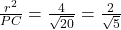
In the right-angled triangle PAC, the length CM is calculated as \frac{r^2}{PC} = \frac{4}{\sqrt{20}} = \frac{2}{\sqrt{5}}.
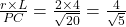
The length of the segment AM (half of the chord AB) is \frac{r \times L}{PC} = \frac{2 \times 4}{\sqrt{20}} = \frac{4}{\sqrt{5}}.
The area of triangle ABC is given by \frac{1}{2} \times AB \times CM, which simplifies to AM \times CM.
Substituting the values: \frac{4}{\sqrt{5}} \times \frac{2}{\sqrt{5}} = \frac{8}{5} sq. units.
Your Score: 0 / 0
Spread the love

Leave a Comment

MCQBits provides free online MCQ practice tests for competitive exams, school exams, and entrance tests in India. Practice chapter-wise multiple choice questions, previous year papers, and mock tests with answers to improve your exam performance.
Prepare for TSPSC, APPSC, TS Polycet, CBSE Class 10, SSC,UPSC, RRB and other government exams with regularly updated quizzes and important questions.
About Us | Contact Us | Privacy Polocy
error: Content is protected !!