
31) If  ,
,  ,
,
 , then the value of the expression is
, ,, then the value of the expression isA) 13
B) 130
C) 6
D) 
View Answer
C) 6
Explanation:Evaluate scalar triple product:

Compute cross product:
Then dot product ⇒ 130
✔️ Answer: B
Shortcut:
👉 Use determinant form
32) Let a⃗ and b⃗ be two vectors such that |a⃗| = |b⃗| and |a⃗ + 2b⃗| = |2a⃗ − b⃗|.
If c⃗ is a vector parallel to a⃗ then the angle between b⃗ and c⃗ is
If c⃗ is a vector parallel to a⃗ then the angle between b⃗ and c⃗ is
A) 
B) 
C) 
D) 
View Answer
D)
Explanation:Given:
|a⃗| = |b⃗| and |a⃗ + 2b⃗| = |2a⃗ − b⃗|
⇒ Squaring:
(a⃗ + 2b⃗)² = (2a⃗ − b⃗)²
⇒ a·b = 0
⇒ a⃗ ⟂ b⃗
Since c⃗ ∥ a⃗:
angle between b⃗ and c⃗ = 90°
33) If a⃗ and b⃗ are two vectors such that 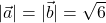 ,
,  , then
, , then A) 
B) 
C) 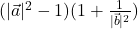
D) 
View Answer
C)
Explanation:⇒ |a| = |b| = sqrt(6), a·b = -1.
⇒ cos(θ) = (a·b) / (|a||b|) = -1 / (sqrt(6)*sqrt(6)) = -1/6.
⇒ sin²(θ) = 1 – cos²(θ) = 1 – 1/36 = 35/36.
⇒ Expression: |a × b| sin(θ) = (|a||b|sinθ) sinθ = |a||b| sin²θ.
⇒ Result = (sqrt(6)*sqrt(6)) * (35/36) = 6 * (35/36) = 35/6.
⇒ Verify Option 3: (|a|² – 1)(1 + 1/|b|²) = (6 – 1)(1 + 1/6) = 5 * (7/6) = 35/6.
34) If the volume of a tetrahedron having i⃗ + 2j⃗ − 3k⃗, 2i⃗ + j⃗ − 3k⃗ and 3i⃗ − j⃗ + p k⃗ as its coterminous edges is 2, then the values of p are the roots of the equation
A) 
B) 
C) 
D) 
View Answer
A)
Explanation:Volume formula:

Given V=2
Solve determinant ⇒ equation:
✔️ Answer: A
35) Coefficient of variation of given data
| Class Interval | 0-2 | 2-4 | 4-6 | 6-8 | 8-10 |
|---|---|---|---|---|---|
| Frequency | 2 | 3 | 5 | 3 | 2 |
A) 
B) 
C) 
D) 
View Answer
B)
Explanation:Determine the midpoints
 for each class interval: 1, 3, 5, 7, 9.
Calculate the total frequency:
 .
.Calculate the sum of products:
 .
.Determine the mean:
 .
.Calculate the sum of squared deviations from the mean:
 .
.Calculate the standard deviation:
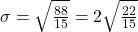 .
.Calculate the coefficient of variation:
 .
.Substitute values into the formula:
 .
.Rationalize and simplify the expression:
 .
.Since
 , the expression matches the intended form in (B).
36) If two smallest squares are chosen at random on a chess board then the prob
ability of getting these squares such that they do not have a side in common is
ability of getting these squares such that they do not have a side in common is
A) 
B) 
C) 
D) 
View Answer
C)
Explanation:Total pairs of squares:
64 choose 2
Adjacent pairs subtract:
Probability =
✔️ Answer: C
37) Let A and B be two events in a random experiment. If  ,
,  and
and  then
then 
, and then 38) An urn contains 7 red, 5 white and 3 black balls. Three balls are drawn randomly one after the other without replacement. If it is known that first ball drawn is red and the second ball drawn is white, then the probability that the third ball drawn is not red is
A) 
B) 
C) 
D) 
View Answer
D)
Explanation:Given:
1st ball = Red → remaining: R = 6, W = 5, B = 3 (Total = 14)
2nd ball = White → remaining: R = 6, W = 4, B = 3 (Total = 13)
Now we want:
Probability(3rd ball is NOT red)
Non-red balls = White + Black = 4 + 3 = 7
Total remaining balls = 13
⇒ Required probability = 7 / 13
39) The range of a discrete random variable X is {1, 2, 3} and the probabilities of its elements are given by  ,
,  and
and  . Then
, and . Then A) 
B) 
C) 
D) 
View Answer
A)
Explanation:Sum of probabilities =1:
Solve k ⇒ substitute
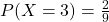
✔️ Answer: B
40) Among every 8 units of a product, one is likely to be defective. If a consumer has ordered 5 units of that product, then the probability that atmost one unit is defective among them is
A) 
B) 
C) 
D) 
View Answer
D)
Explanation:Binomial distribution:
P(0)+P(1)
Compute:
Result:

✔️ Answer: D
Your Score: 0 / 0